
Frameless goggles aren’t just a trend—they’re a complete rethink of how we see the mountain. With their minimalist silhouette and futuristic look, they’ve dominated the slopes for several seasons. But when you strip away the protective rim of a traditional frame, a critical question remains: Are we sacrificing safety for a wider view?
The Engineering Logic: Eliminating “Tunnel Vision”
The FOV Problem in Traditional Frames
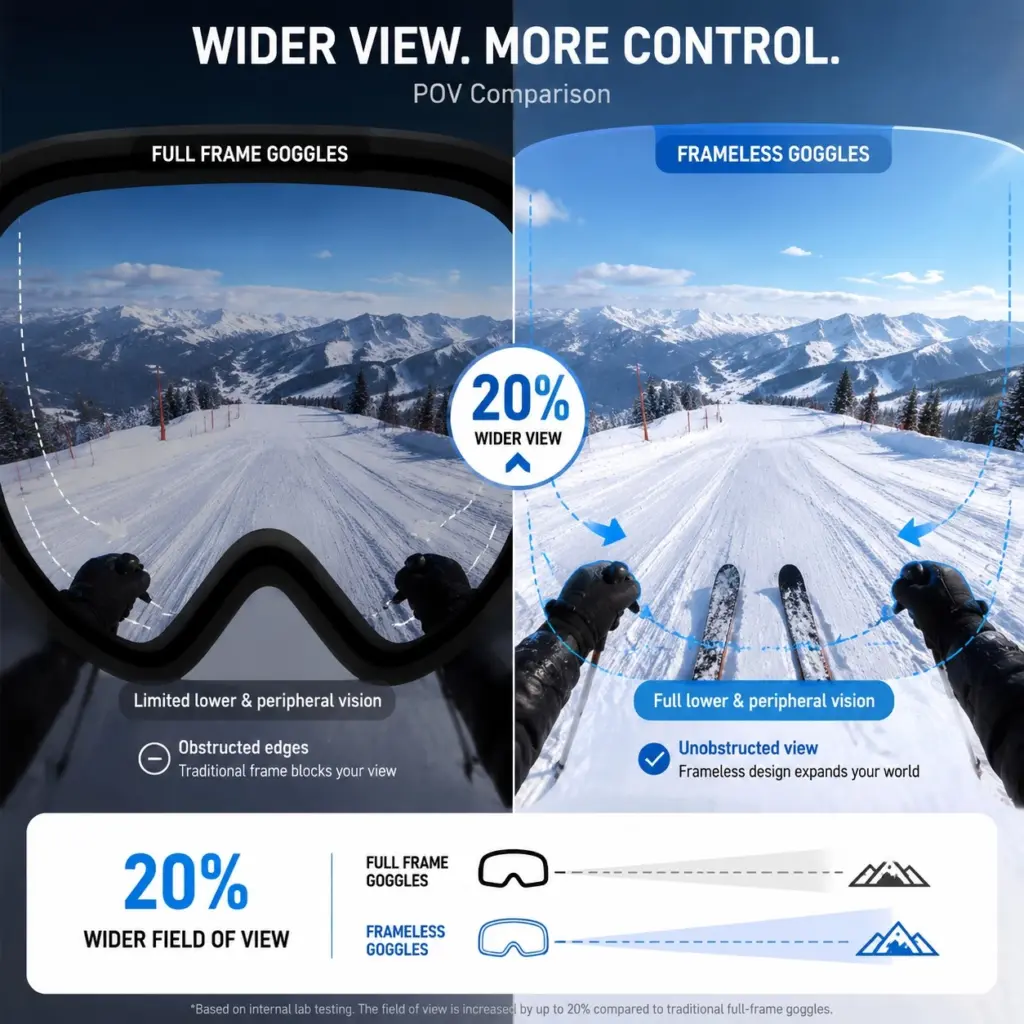
Standard goggles use a 2–3mm plastic rim to hold everything together. While it seems small, that rim creates a literal blind spot, blocking terrain cues in your lower peripheral vision during high-speed descents. Going frameless expands your peripheral field of view by roughly 20%.
The Need for Lighter Gear
Removing the full frame shaves off 20–30 grams. That might not sound like much, but it significantly reduces equipment inertia. When you’re twisting through trees or landing a jump, you feel less “pull” on your face. It simply stays put.
Structural Engineering Challenges
Lens Edges: From Component to Shield
In a traditional setup, the frame acts as a bumper. Without it, the lens edge is the first thing to hit the ground. This requires the lens itself to be much tougher—it has to transition from a passive optical layer to a structural shield capable of handling direct impacts.
Fixing the Lens: Clamping vs. Bonding
Mechanical Clamping
Some frameless designs use upper-edge slot mechanisms to lock the lens to the bridge. This allows for quick lens swaps but requires extremely high machining tolerances to prevent rattling.
Structural Bonding
Other designs use industrial-grade adhesives to permanently bond the lens to the top frame. This creates a solid, unified structure but means you can’t swap lenses on the fly.
Material Science: The Structural Lens
Increasing Lens Thickness
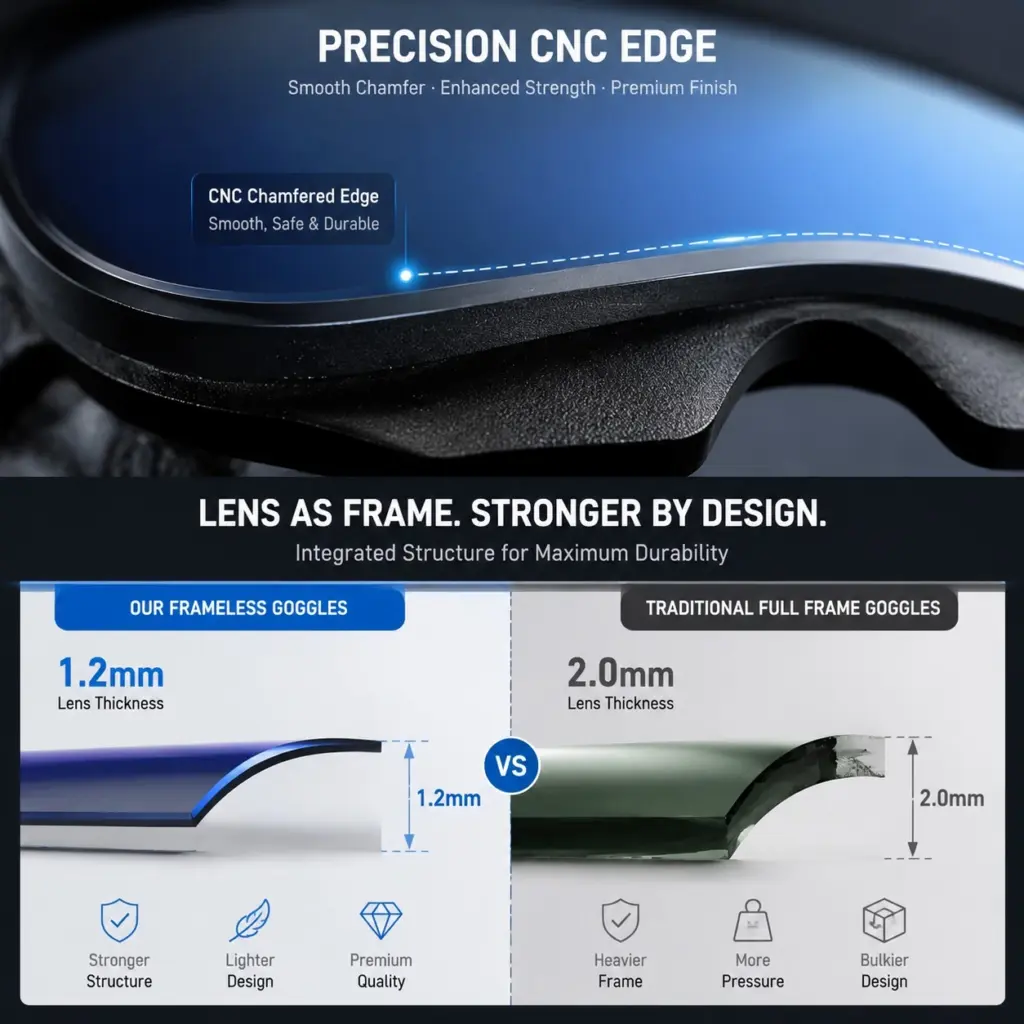
In frameless goggles, the lens is the load-bearer. To compensate, manufacturers have increased lens thickness from the standard 1.2mm to 1.8mm or even 2.0mm. This extra mass improves impact resistance and cuts out the visual distortion common in thinner lenses at speed.
Edge Finishing Techniques
CNC Chamfering
To prevent chipping, high-end lenses undergo CNC edge chamfering. This rounds off the edges to eliminate “stress points” where micro-cracks usually start.
Edge Hardening
Some premium models apply chemical tempering or reinforced coatings to the lens edge, giving it a level of durability that rivals a traditional plastic frame.
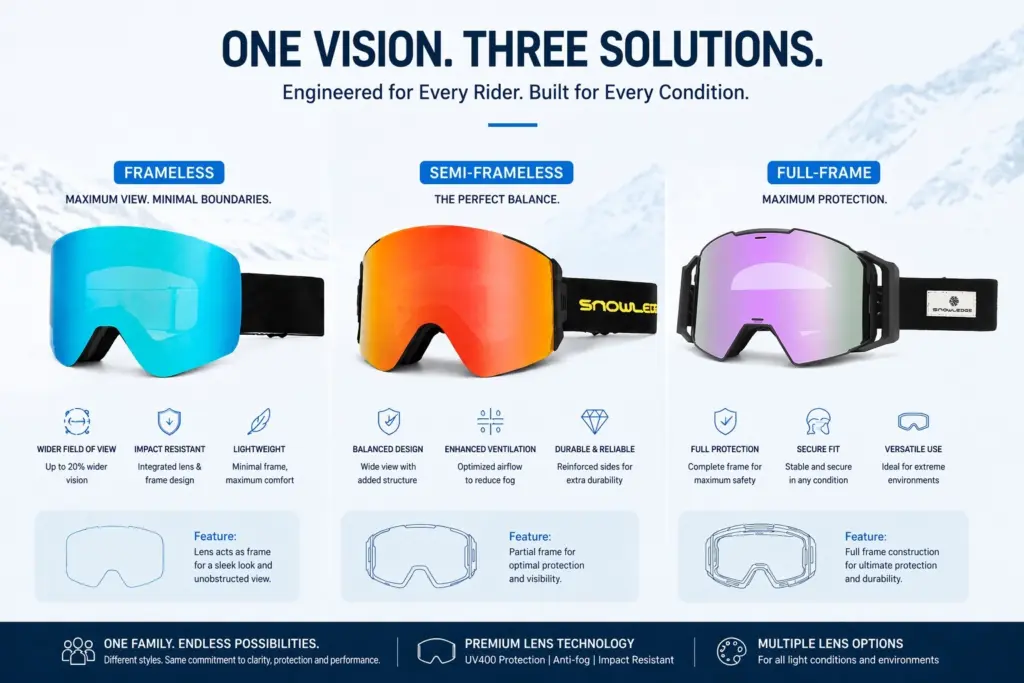
Comparison: Full-Frame vs. Semi-Frameless vs. Frameless
For the Vision Purists: Frameless
If you’re a backcountry enthusiast who needs to see every ripple in the snow, frameless is the clear choice. However, you have to be more disciplined with storage—without a frame, daily bumps can do more damage.
The Reliable All-Rounder: Full-Frame
If you ski occasionally and hit mixed terrain, traditional full-frames are far more forgiving. They absorb the knocks of travel and daily use so you can focus entirely on your technique.
The Sweet Spot: Semi-Frameless
Top-Frame Support
These designs keep a frame on top for ventilation and rigidity but leave the bottom frameless for an open field of vision.
The Hubo Sports Approach
At Hubo Sports, we offer both lightweight semi-frameless models and rugged full-frame options to match your specific riding style.
Maintenance and Longevity
Protecting the Exposed Edge
When storing frameless goggles, a dedicated microfiber bag is non-negotiable. It acts as the first line of defense against the micro-friction that happens during travel.
Proper Cleaning Technique
When wiping the lens, support it from the center. Avoid applying too much pressure to the edges, as this can cause an invisible shift in the optical alignment of thicker lenses.
Final Verdict
Matching Gear to Your Philosophy
Frameless goggles are a bold step forward in visual design. Whether you go frameless or stick with a traditional build, professional equipment is about finding that perfect line where aesthetics, vision, and protection meet.