 Перейти к содержанию

More than 60% of adults in North America and Western Europe require vision correction. For winter sports enthusiasts who wear prescription eyeglasses, hitting the slopes presents a persistent engineering challenge: fogged optical lenses, painful temple pinch, and unstable frame movement under helmet pressure. For sports eyewear brand owners, distributors, and product managers, developing a competitive OTG (Over-The-Glasses) ski goggle is not merely a matter of scaling up frame dimensions. It demands precise frame cavity geometry, calibrated triple-layer face foam channels, dual-microclimate ventilation management, and certified impact retention.
In this comprehensive OEM/ODM manufacturing guide, we examine the structural engineering, optical dynamics, material selection, and tooling considerations required to produce high-performance private label OTG snow goggles that deliver uncompromised clarity and comfort for prescription wearers.
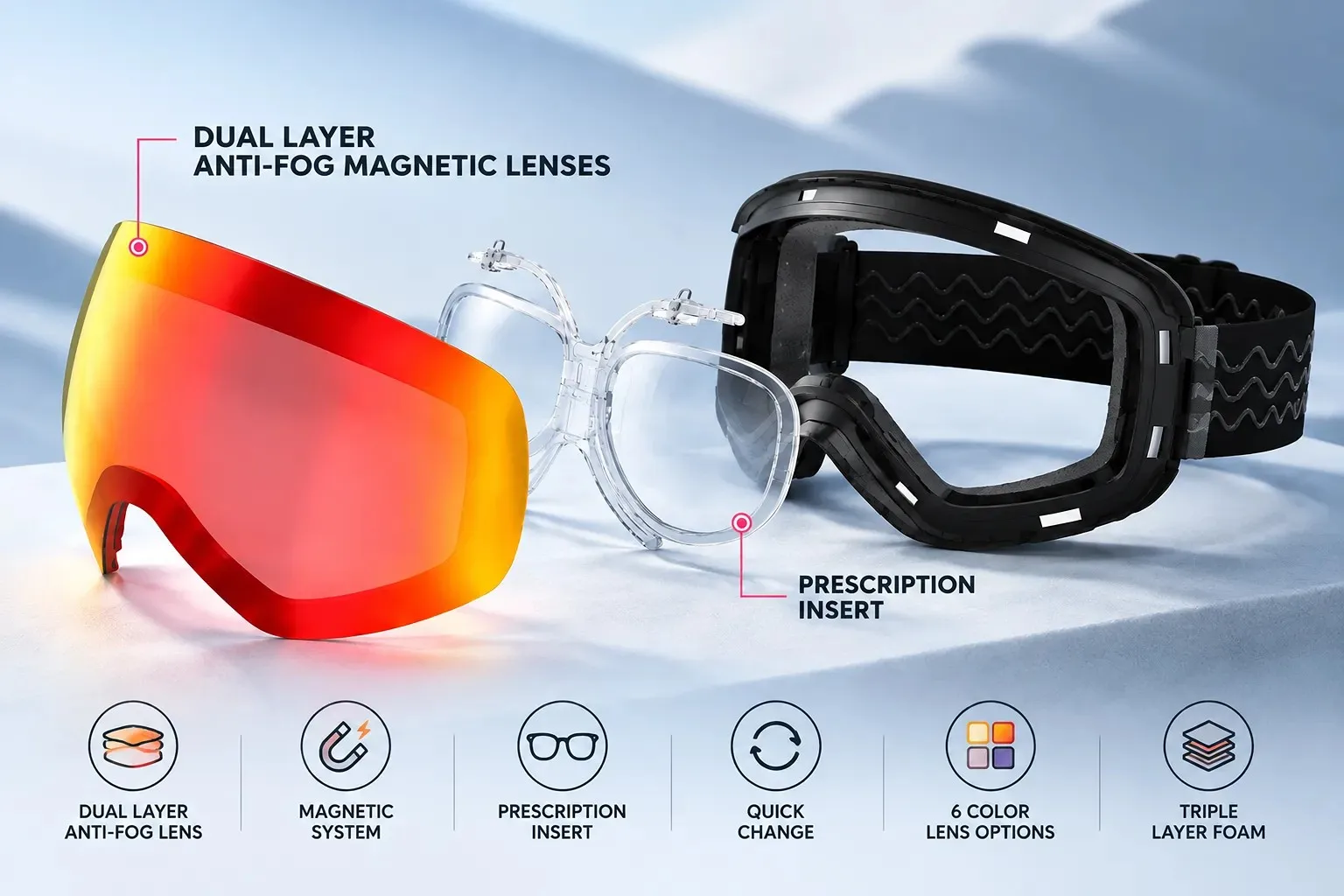
Anatomy of an OTG Goggle Frame: Core Engineering Dimensions
The core objective of an OTG chassis is to float the goggle frame and lens assembly over the wearer’s eyeglasses without exerting mechanical pressure on the spectacle frame or creating contact between the two lens surfaces. Achieving this requires strict adherence to three critical dimensional thresholds during mold tooling development:
| Dimensional Parameter | Standard Ski Goggle Range | Engineered OTG Goggle Range | Engineering Purpose & Benefit |
|---|---|---|---|
| Internal Chamber Depth | 12 mm – 16 mm | 20 mm – 26 mm | Maintains safe physical clearance between optical lenses and inner goggle shield; prevents scratches during impact. |
| Horizontal Temple Width | 125 mm – 132 mm | 138 mm – 148 mm | Accommodates standard and oversized prescription frame widths without side-wall inward compression. |
| Temple Relief Channel Width | None / Minimal | 12 mm – 16 mm | Eliminates temple arm pressure against the temporal bone while maintaining wind and snow dust sealing. |
| Nose Bridge Cutout Depth | Standard shallow arch | Extended arch (8 mm – 12 mm deeper) | Prevents goggle frame weight from driving the eyeglass nose pads painfully into the rider’s nasal bone. |
During injection molding of the flexible Thermoplastic Polyurethane (TPU) chassis, wall thickness around the temporal notches must be carefully balanced. If the side walls are too thin, structural rigidity collapses under tight strap tension; if too rigid, the goggle fails to conform to diverse cranial contours. Hubo Sports molds utilize shore 85A–90A TPU formulations that maintain elastic flexibility even at sub-zero temperatures down to -35°C.
Triple-Layer Foam Technology: Density, Airflow & Pressure Relief
Standard single-layer or generic double-layer foam fails rapidly in OTG applications because the rigid temples of prescription glasses create concentrated pressure points. A specialized triple-layer composite face foam architecture is essential to distribute load, seal out perimeter wind, and absorb facial perspiration.
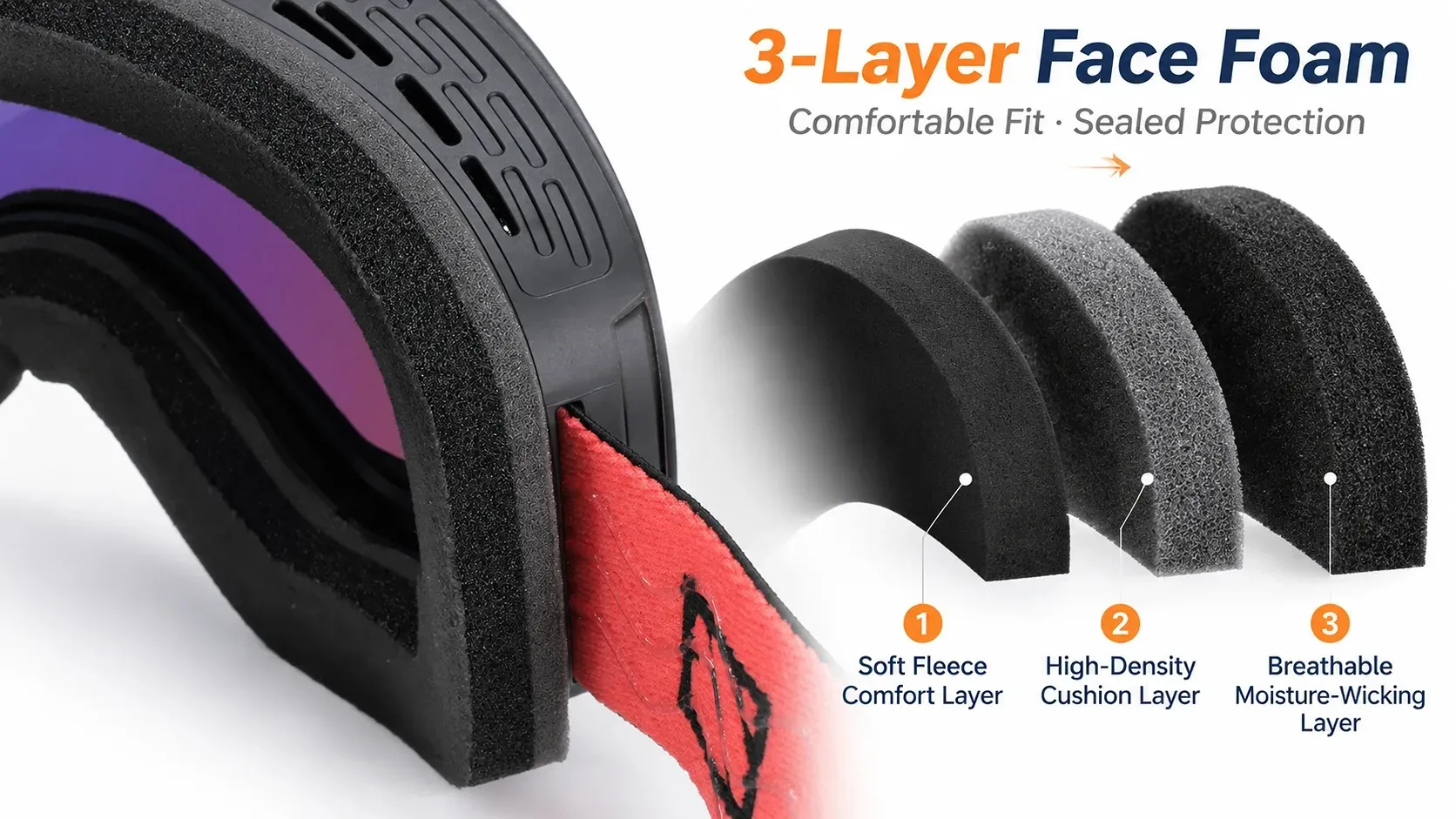
An optimized OTG foam stack incorporates three distinct functional layers:
- Layer 1 (Structural Sub-Base): High-Density Reticulated PU Foam (40–45 kg/m³). Bonded directly to the TPU frame rim, this 6mm–8mm base layer provides structural integrity, absorbs high-velocity impact energy, and features precision laser or die-cut channels at the temples to create dedicated clearance corridors for glasses arms.
- Layer 2 (Adaptive Cushioning): Medium-Density Open-Cell Memory Foam (25–30 kg/m³). A 5mm–7mm intermediate layer that dynamically conforms to irregular eyeglass frame silhouettes, bridging microscopic air gaps around the temples to eliminate wind whistling without pressing the glasses against the rider’s face.
- Layer 3 (Skin Interface): Ultra-Soft Hypoallergenic Microfleece Liner. A brushed 1.5mm fleece face fabric that touches the skin. In premium OTG builds, this fabric is engineered with directional elasticity to bridge the temple channel seamlessly, preventing raw foam exposure while maintaining an unbroken perimeter seal.
By engineering calibrated density transitions across these three foam strata, brands can eliminate the common customer complaint of “eyeglass temple headache” during long sessions on the mountain.
Anti-Fogging Dynamics: Managing the Dual-Microclimate Challenge
Fogging is the number one cause of product returns in winter sports eyewear. In standard goggles, moisture control involves a single microclimate: the chamber between the goggle lens and the wearer’s face. In an OTG goggle, however, prescription glasses introduce a dual-microclimate dilemma:
The primary goggle lens is treated with a factory hydrophilic anti-fog coating on its inner Cellulose Propionate (CP) or TAC substrate. However, the wearer’s prescription eyeglasses are uncoated optical glass or CR-39 plastic. As facial heat and sweat evaporate from the ocular orbit, the warm, moisture-laden air immediately condenses on the cooler prescription lenses.
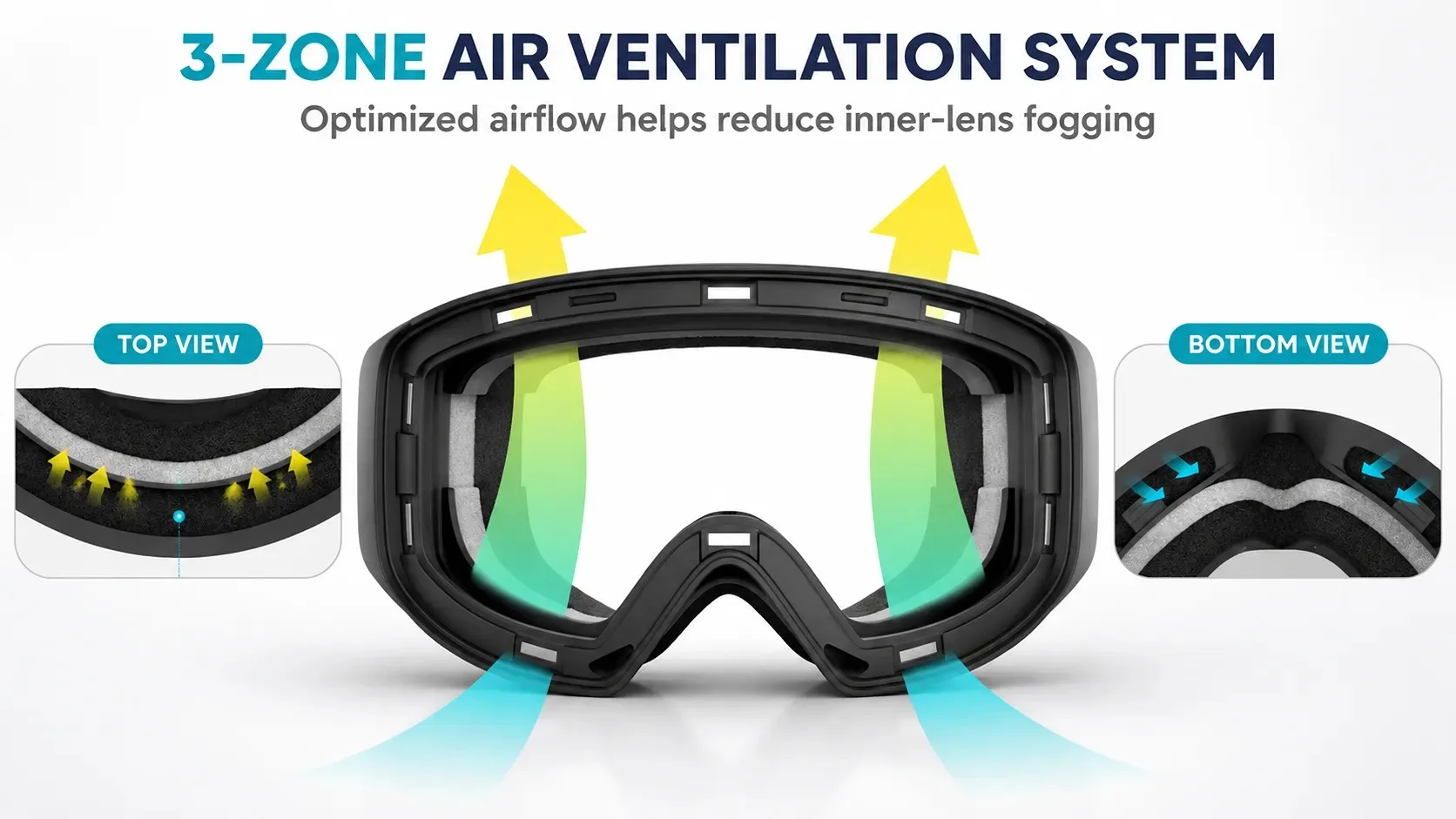
Engineered Solutions for OTG Moisture Evacuation
To overcome the dual-microclimate barrier, Hubo Sports engineers implement three complementary airflow and thermal systems:
- Chimney-Effect Perimeter Venting: High-permeability 30–45 PPI (pores per inch) reticulated foam filters are placed over oversized top and bottom ventilation ports. Bottom intake scoops draw cool ambient air inward during forward movement, while top exhaust vents leverage convective buoyancy to pull moist air up and out before it condenses on prescription glass.
- Dual-Pane Thermal Barrier: An injection-molded optical Polycarbonate (PC) outer shield is bonded to a premium anti-fog inner lens via a closed-cell silicone foam spacer gasket. This creates an airtight insulating vacuum pocket that prevents outside sub-zero temperatures from chilling the interior chamber.
- Extended Nose Pocket Seal: An ergonomic nose contour separates the mouth and nose exhaust from the upper ocular chamber, preventing humid exhalation from rising under the goggle rim during intense breathing on chairlifts or ski touring ascents.
Comprehensive Comparison: OTG vs. Standard Goggles vs. Prescription Inserts
When curating a seasonal winter sports catalog, brand managers often evaluate three optical approaches for prescription skiers. The following matrix details their technical trade-offs:
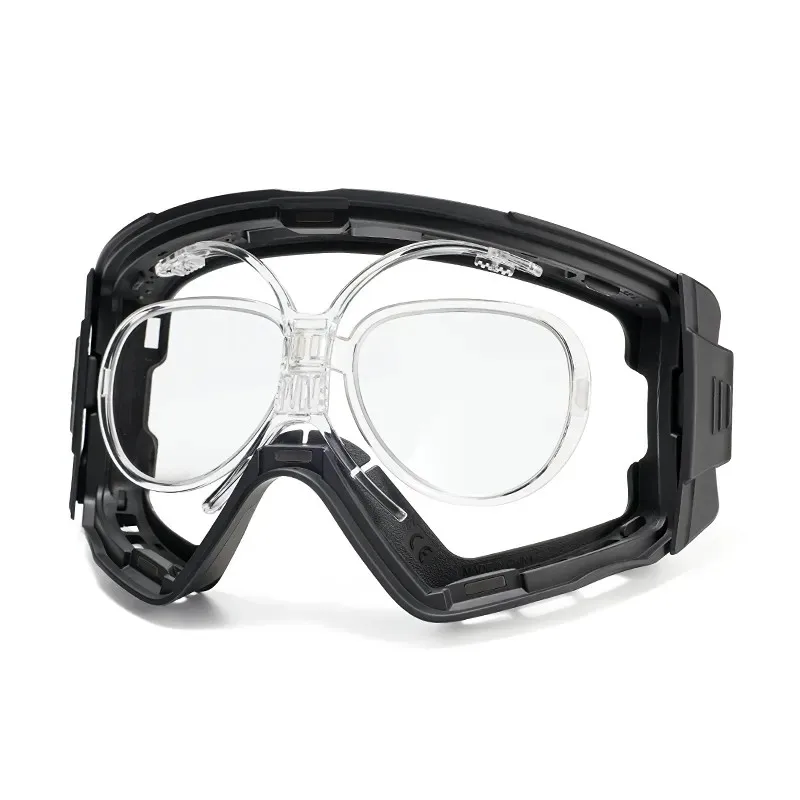
| Evaluation Factor | Engineered OTG Ski Goggles | Standard Ski Goggles | Prescription Optical Clip-Ins (Rx Inserts) |
|---|---|---|---|
| Eyeglass Accommodation | Direct fit over 95%+ of standard eyeglass frames. | Incompatible; crushes frames against temples. | Requires custom-glazed adapter clipped into nose bridge. |
| Consumer Purchase Barrier | Zero; ready to ride immediately out of the box. | Requires contact lenses for vision-corrected riders. | High; customer must visit an optician to glaze insert lenses. |
| Field of View (FOV) | Wide peripheral vision; 180°+ horizontal arc. | Standard 160°–180° field. | Slightly restricted by adapter rim inside frame. |
| Tooling & Unit Cost | Moderate tooling investment; high consumer retail value. | Standard baseline tooling and manufacturing cost. | Requires secondary mold for Rx clip insert accessory. |
| Retail Audience Coverage | Broad; covers both prescription wearers and regular riders. | General audience only (no eyeglass compatibility). | Niche; requires optical store partnership or aftermarket sourcing. |
OEM/ODM Customization & Tooling Considerations for Brand Owners
Developing an OTG product line with a specialized OEM manufacturer like Hubo Sports provides gear brands with flexible private-label customization options across every goggle component:
- Modular Lens Options: Cylindrical, Spherical, or Toric double lenses engineered in optical PC with full REVO mirror coatings, contrast-enhancing high-definition tints (Rose, Amber, Smoke), and Category 1 to Category 4 VLT ratings.
- Magnetic Quick-Change Compatibility: Secure N45/N52 neodymium magnet arrays integrated into the OTG frame brow and base, allowing rapid 3-second lens swaps in changing alpine light conditions without disturbing prescription eyeglasses.
- Custom Strap Branding: 40mm to 50mm high-elasticity woven nylon straps with triple wavy anti-slip silicone beads, sublimated custom graphic art, or 3D raised jacquard logo embroidery.
- Branded Packaging & Accessories: Custom EVA hard-shell storage cases, dual-compartment microfiber cleaning bags (with an interior pocket for spare low-light lenses), and eco-friendly FSC-certified retail boxes.
International Quality Standards & Impact Compliance
To distribute sports eyewear across North American, European, and Asian commercial channels, OTG ski goggles must satisfy stringent international optical and safety standards. Hubo Sports manufactures and tests production batches against major global benchmarks:
- CE EN ISO 18527-1:2021: European standard for downhill skiing and snowboarding goggles, covering optical power deviations, field of vision clearance, mechanical high-speed particle impact resistance at extreme temperatures (-20°C and +50°C), and anti-fog duration.
- ANSI Z87.1 / ASTM F659: North American standard for high-mass and high-velocity steel ball projectile impact resistance, optical clarity, UV400 filtration (100% UVA/UVB blockage up to 400nm), and flame retardancy of face foam.
- ISO 9001 & BSCI Certified Facility: Full manufacturing traceability from raw Bayer/Sabic polycarbonate pellets to cleanroom lens coating, automated foam die-cutting, assembly, and final pre-shipment AQL 1.5 inspection.
Launch Your Custom OTG Ski Goggle Line with Hubo Sports
Whether you are expanding an established alpine sports brand with dedicated prescription-friendly models or launching a new DTC eyewear collection, Hubo Sports offers flexible OEM/ODM cooperation models. Our engineering team provides complete Design for Manufacturability (DFM) reviews, 3D rapid prototyping within 7–10 days, and low MOQ private-label production starting at 300–500 pieces per colorway on proprietary tooling.
Contact our sports optics engineering team today to request technical drawings, discuss custom frame mold tooling, and order physical evaluation samples for your upcoming winter collection.


 Russian
 English
 Arabic
 French
 German
 Hindi
 Italian
 Japanese
 Korean
 Portuguese
 Spanish