Have You Ever Seen This Situation?
- Traditional Anti-Fog Always Fail When You Need It Most.
- The Natural Flaw of Passive Venting: Fog Depends on Wind Speed.
- It Clears While You Ski, But Fogs As Soon As You Stop.
Most ski goggles rely on fixed vents in the frame for anti-fog. When you’re carving at speed, airflow carries away moisture. But the moment you slow down, stop to wait for friends, ride the chairlift, or hike up – airflow drops to near zero, and warm, humid air instantly condenses on the inside of the lens. This isn’t a quality issue; it’s the physical ceiling of passive venting.
The downsides of conventional “push-to-vent” goggles: narrow gap, slow defog, clumsy operation
Some vented goggles do let you open a slit, but the gap is often only a millimeter or two – defogging takes ten seconds or more. Others require fingernail precision or two hands to operate, which is impossible with thick gloves.
Effective Active Venting Must Meet Three Conditions
The gap must be large enough to expel humid air instantly
If the vent gap is too small, air exchange is inefficient, and fog clears slowly. True high-efficiency defogging needs a wide opening that replaces warm, moist air with cold, dry air inside the goggle in about one second.
Operation must be simple enough for one hand with thick gloves
When you’re wearing thick, stiff ski gloves, a mechanism that needs precise alignment or fingernail leverage is useless. Good design should allow blind, one-handed operation by anyone, regardless of finger size.
The seal must be absolute when closed – no wind or snow intrusion
A large vent gap means sealing is harder. If the lens doesn’t close tightly, cold wind will rush in at high speed, drying out your eyes and making them water. The closed seal must be as reliable as that of a fixed-lens goggle.
Our Solution: Side-Push Wide Gap + Hidden Magnets – 1 Second Defog

Push the Side Frame Forward: One Motion, Lens Pops Out Entirely
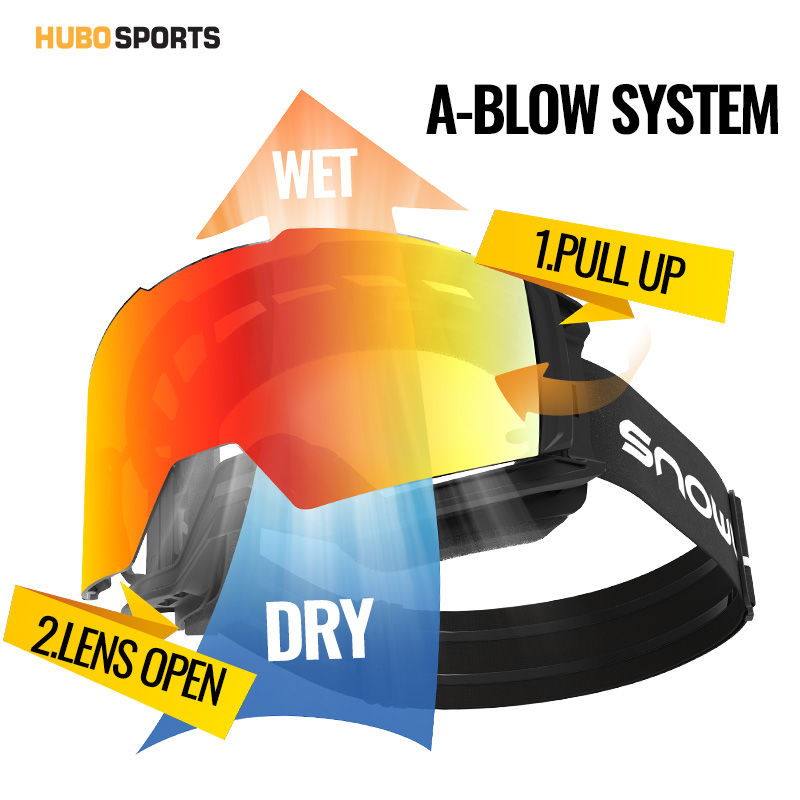
How it works: Push the slider on each side of the frame; the lens moves forward in parallel on precision rails
Our vent mechanism is located on the left and right sides of the frame. When you push the side frame forward with one finger, the lens assembly moves forward in parallel, guided by precision rails and assisted by a spring. This action requires only one finger and works with any thickness of ski glove.
The vent gap is not a “slit” – it’s a full perimeter of open space
Unlike conventional vented goggles that open only a small slit, our lens pops forward to create a complete, uniform gap between the lens and the frame. The width of this gap is precisely calculated to maximize air exchange while keeping the lens stable and secure.
How Does “1 Second Defog” Work? High-Volume Air Exchange
Physics principle: The larger the gap, the more air is exchanged per second
Fog inside a goggle is simply warm, humid air condensing on a cold lens. The fastest way to clear it is to replace the internal humid air with cold, dry outside air. Our vent gap cross-section is 3-5 times larger than that of conventional vented goggles, dramatically increasing airflow.
Test results: From fogged to completely clear in just 1 second
We ran comparative tests under identical temperature and humidity (inside goggle: 25°C, 90% RH; outside: -5°C). A standard fixed-vent goggle took more than 20 seconds of skiing to clear naturally. A small-gap vented goggle took 8-10 seconds. Our side-push wide-gap design: push forward – fog in the central area disappears within 1 second, and the edges clear within 2 seconds.
“One push” is enough – you don’t need to keep the vent open
Because defogging is so fast, you only need to push forward when you feel fog starting, wait 1 second for it to clear, then release (or pull back) to let the lens reset. The whole process takes less than 2 seconds – no need to leave the vent open and get cold.
Hidden Magnetic Attraction: Auto-Closes and Seals Like New
Why magnets? – To make the lens “home in” automatically when closing
After the lens pops forward, you need it to return to its original position and seal tightly. With only a mechanical latch, you’d have to press hard until you hear a “click” – difficult with gloves on. We embedded hidden magnets in the frame and lens. When the lens approaches the closed position, magnetic force automatically pulls it into place and maintains closing pressure.
Two benefits of hidden magnets: no dust accumulation, no scratch on fingers
The magnets are completely enclosed inside the plastic housing, invisible from the outside. This prevents tiny iron particles from chairlift cables (which can scratch and dirty the lens) from being attracted to the magnets. It also ensures a smooth feel when operating – your fingers never touch bare magnet edges.
Magnetic force is precisely tuned: won’t open accidentally, but not too hard to push
Magnetic pull must be strong enough to resist vibration and wind at high speed, but not so strong that pushing open requires excessive force. Through repeated testing, we set the total closing pull to around 3kg – crisp to push open, automatic to close, and secure even in rough terrain.
The Core Value of the Side-Push Wide Gap: More Than Just Defogging
The core principle of ski goggle anti-fog is to block direct contact between hot and cold air, quickly discharge moisture and prevent water vapor from adhering. It is usually achieved through the synergy of three technologies: first, temperature difference isolation – double-layer lenses form a constant temperature air interlayer to reduce the temperature difference between the inner and outer lenses and avoid liquefaction of hot air when encountering cold; second, water vapor dispersion – the inner coating absorbs or spreads water vapor to prevent it from forming fog beads; third, air circulation – the ventilation holes on the frame form convection to discharge the hot air from the face and reduce moisture accumulation. A single technology can hardly achieve long-term anti-fog effect; only the combination of the three can ensure stable performance.
Current Implementation Methods of Ski Goggle Anti-Fog Function and Their Comparison
“Vent While Climbing”: Continuous Airflow, No Stuffy Feeling
1.Backcountry touring scenario: 30 minutes of climbing – you can keep the vent open the whole time
During low-speed climbs on a backcountry tour or snowmobile, your body constantly generates heat and moisture. If you keep the goggle closed, humid air builds up, forcing you to stop every few minutes to defog. Our design lets you push the vent open and leave it open – the magnetic force is strong enough to prevent accidental closing. You can climb with the vent open, keeping the inside of the goggle dry.
2.Will snow get in with the vent open? – The gap orientation prevents direct entry
The orientation of our vent gap is optimized so that, in a normal skiing posture, snow particles rarely enter directly from the front. Even if a few flakes get in, they are blocked by the foam filter layer inside the frame.
“Instant Open/Close” on the Chairlift: Fog No Longer Rides With You
1.The problem: Chairlifts are fog hotspots
After intense skiing, your body is hot. The moment you sit on the lift and stop moving, humid air has nowhere to go and fog rapidly forms on the lens. Many skiers end up removing their goggles and freezing their eyes for the entire lift ride.
2.Our solution: One push on the lift – 1 second defog – then let it close
When you feel fog starting, push the side frame forward with one hand. Fog clears in 1 second. Release – the magnets automatically pull the lens back. Done. No need to remove the goggle, no need to take off gloves, no need to wipe.
A Favorite for OTG (Over-the-Glasses) Users: Rapid Clearing of “Interlayer Fog”
1.The interlayer fog problem: Moisture trapped between the goggle lens and your prescription glasses
The biggest pain point for OTG users is the air gap between the goggle’s inner lens and their glasses. This space fogs easily and is impossible to wipe. Traditional fixed vents struggle to move air into this gap.
2.How the wide gap solves it: Dry air flows directly into the interlayer
When the lens pops forward, the vent gap runs around the entire perimeter of the lens. Dry outside air can enter the space between the goggle lens and your glasses from all directions. In our tests, interlayer fog clears more than 5 times faster than with fixed vents alone.
Taking Photos, Checking Your Phone, or Talking – No Need to Remove the Goggle
1.The problem: Taking off your goggle every time you look at your phone is annoying and risky
When you want to snap a photo, check the trail map, or reply to a message, you typically have to push the goggle up onto your helmet or remove it entirely – clumsy with one hand, and easy to drop in the snow.
Our solution: Push the lens open for a clear view, then let go to close
With the lens pushed open, you get a clear, unobstructed view while the frame and foam still stay on your face – no shifting. When you’re done, simply release, and the lens snaps back by itself. No removal, no re-adjustment.
Technical Details: How the Wide Gap + Hidden Magnets Work
Dual-rail guidance: ensures parallel movement, no tilting
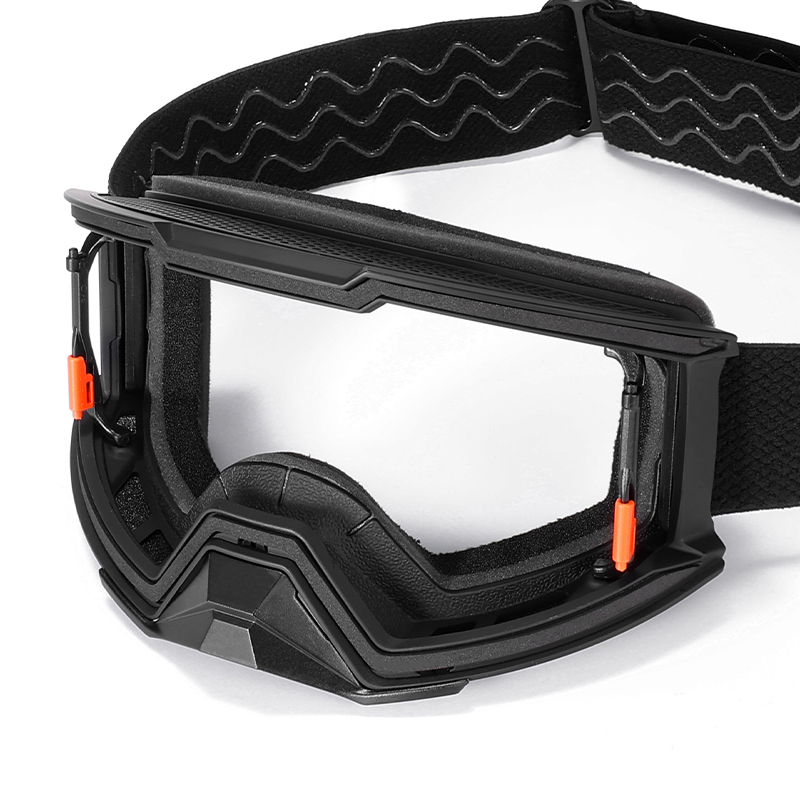
We placed a precision rail along the top and bottom edge of the frame. Corresponding sliders on the lens assembly ride in these rails. When you push forward, the lens moves straight ahead in parallel, without tilting left/right or up/down. This guarantees perfect alignment when closing.
Spring-assisted pop-out: one push, fully open every time
A micro spring is pre-loaded inside the rail. When you push the side frame past a certain threshold, the spring takes over and completes the pop-out stroke, ensuring the lens reaches the full vent position every time – no “half-open” jams.
Hidden Magnet Layout and Tuning
*Magnet placement: one magnet embedded in each side of the frame, one in each side of the lens (4 total) – point-to-point attraction
The magnets are completely enclosed inside the plastic housing of the frame and lens, never exposed to the outside. This means you never have to worry about sweat or moisture causing corrosion. The point-to-point layout ensures even closing force – no corner lifting.
*Magnetic force tuning: strong enough to hold, easy enough to push open
We tuned the total closing pull to approximately 3kg. This is strong enough to resist vibration and wind at high speed, yet an adult can push it open with one hand without excessive effort.
How to Use: Scenarios and Operation Guide
Scenario 1: Resort Skiing – 1 Second Defog on the Chairlift
Operation: On the lift, if you feel fog starting, push the side frame forward with one hand
The lens pops out, fog clears in 1 second. Release – the magnets pull the lens back. Entire process under 3 seconds.
Scenario 2: Backcountry Climbing – Keep the Vent Open Continuously
Operation: Before you start climbing, push the side frame forward to the open position and leave it
Because the magnetic pull in the open position is negligible, the lens won’t close by itself. You can climb with the vent open. When you’re ready to ski down, push the lens back with your hand until you feel it snap shut.
Scenario 3: OTG Users – Quick Interlayer Fog Rescue
Operation: Push the lens open for 2-3 seconds to let dry air flush the interlayer
The full-perimeter vent allows outside air to enter the space between your glasses and the goggle lens, rapidly carrying away moisture. Then close – vision restored.
Scenario 4: Taking Photos or Using Your Phone
Operation: Push the lens open, do what you need, then release
No need to remove the goggle or take off gloves. The lens automatically returns to the closed position, and the goggle stays perfectly aligned on your face.
Maintenance and FAQs

Cleaning the Rails
Every 5-10 ski days, use a soft brush or air blower to clean the rail gaps
Iron particles from chairlift cables and snow dust can accumulate in the rails. Clean with a dry soft brush or air blower. Do not use oil-based lubricants – oil attracts more dirt.
Will the Magnets Lose Strength Over Time?
Under normal use, magnetic degradation is very slow
Our magnets are fully sealed inside plastic, protected from moisture and corrosion. After 3-5 years of normal use, magnetic strength remains above 95% of the original.
Will the Lens Close Unexpectedly in Rough Terrain?
No. The magnetic pull when fully open is negligible
When the lens is fully popped out, the magnets are far apart – their pull is too weak to pull the lens back. Only when you manually push the lens close to the closed position does the magnetic force “take over” and complete the closure.