
Fogged lenses are something almost every skier has run into. It happens on easy groomed runs and deep in the backcountry alike. Once a layer of mist settles on the inside of the lens, the view turns soft and gray. Your rhythm breaks, and the situation quickly becomes unsafe.
Most ski goggles handle fog passively, with a dual-pane lens and vent holes in the frame. That setup is fine in mild conditions. In sub-zero temperatures, during hard skiing, or under a sealed helmet where you are breathing heavily, the vents reach their limit. The fog keeps coming back, and you end up pulling the goggles off to wipe them over and over.
Heated goggles work differently. They warm the lens directly, and the lens stays clear for a full day on the mountain.
Why Vented Goggles Fog Up
How Passive Airflow Is Supposed to Work
A vented goggle relies on air moving through the openings at the top and bottom of the frame. That airflow carries the warm, damp air you exhale out of the space between your face and the lens.
Where the Airflow Breaks Down
Conditions on a real mountain are rarely that simple. On a foggy or humid day, with a helmet wrapped tightly around your face, you push a lot of moisture into a small pocket of very cold air. The warm air meets the cold lens and water condenses on the inner surface almost immediately.
The Cost on the Run
Plenty of skiers get only a few hundred meters down a run before the lens turns white. The only fix is to stop, take the goggles off, and wipe.
Hands, Energy, and Rhythm
Doing that repeatedly in freezing wind puts your hands at risk of frostbite, burns energy, and ruins the flow of the run.
Terrain Reading and Collision Risk
In steep alpine terrain the stakes are higher, since you need to read the snow and spot obstacles ahead of you. A blurred lens is how collisions and bad falls happen.
How the Heating System Works
Sensing Inside the Lens Cavity
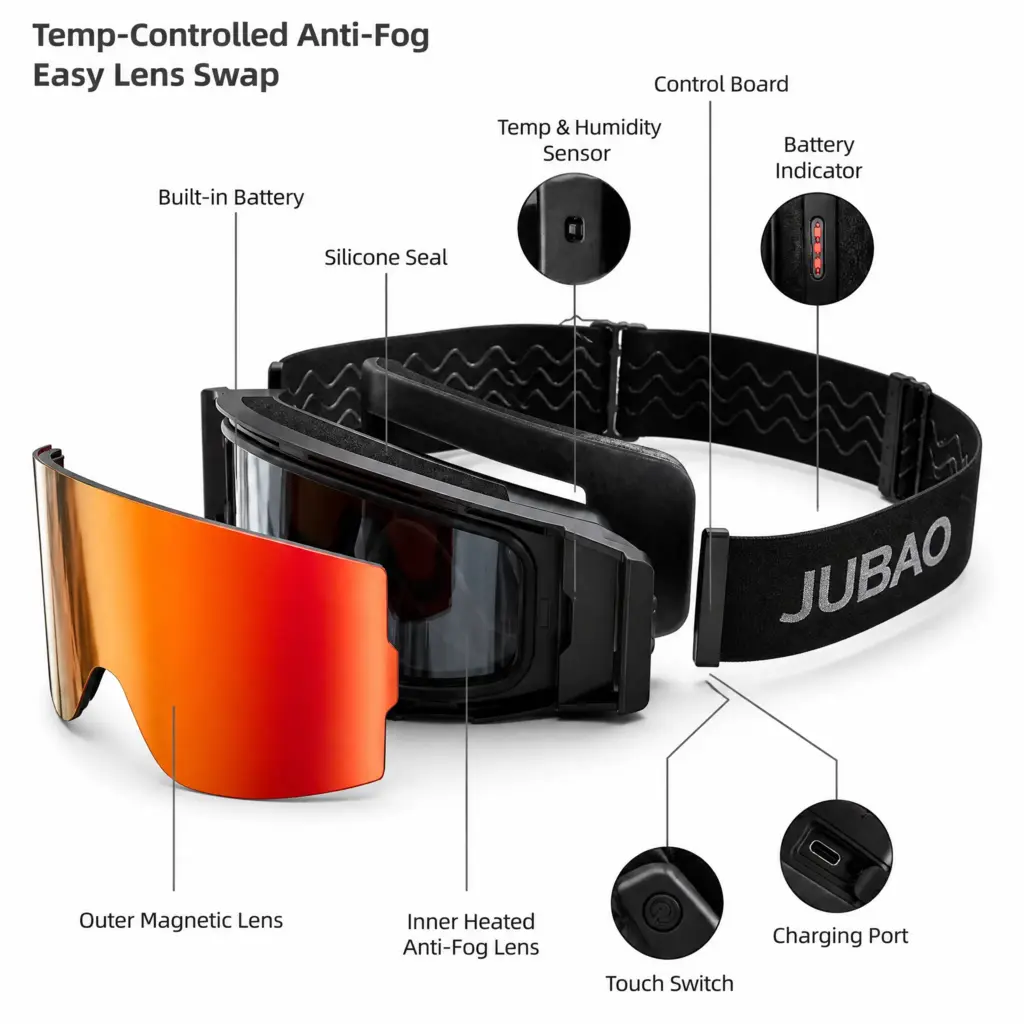
A heated goggle carries a temperature and humidity sensor along with a small control chip. The sensor reads conditions inside the lens cavity continuously. When the readings reach the dew point where fog forms, the system switches on the heating film by itself.
PWM-Controlled Heat Output
Staying Ahead of the Moisture
Heat output runs through PWM control, so the power pulses instead of staying on at full strength. Condensation evaporates within a few seconds and the lens clears.
The chip keeps adjusting output as conditions change, which holds the fog down without draining the battery on heat you do not need. Even with a full-coverage helmet on all day and heavy breathing, the system stays ahead of the moisture and the lens holds clear.
Battery Life in the Cold
An Integrated Low-Temperature Cell
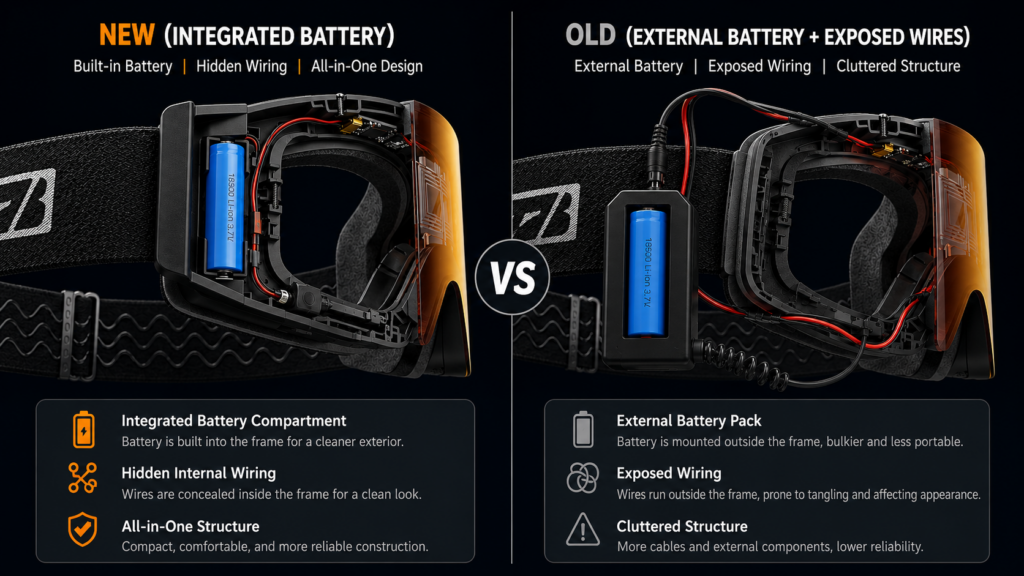
Runtime is what decides whether a heated goggle is genuinely useful. Better models use a lithium cell rated for low temperatures, built into the frame itself. Older designs hung the battery outside with loose wiring, which made them bulky and easy to feel against your face. An integrated cell keeps the shape clean and stays out of the way.
Full-Day Runtime and USB-C Charging
Capacity should cover a full day of lift laps. Charging goes through a standard USB-C port, so a power bank or a car charger tops it up whenever you have a few minutes.
Output at -20°C
At -20°C in high alpine conditions the cell still puts out steady power, instead of cutting off the way ordinary batteries do in the cold.
Swappable Outer Lenses
The Modular Lens Architecture
Defogging is only part of the experience. Most heated goggles use a modular lens design: the heating element sits on the inner anti-fog lens, and the outer lens attaches with magnets.
Changing Tint as the Light Change
Light on the mountain changes through the day, from bright sun to flat overcast to late afternoon. With a magnetic mount you can swap in an outer lens with a different tint in seconds, gloves still on, and one pair of goggles covers all of it.
Replacing One Piece Instead of the Whole Goggle
If the outer lens gets scratched, you replace that piece instead of throwing out the whole goggle, which keeps the long-term cost down.
Foam, Seal, and Helmet Fit
Multi-Layer Foam and Silicone Seal
The face foam is multi-layer, high-density, and breathable, backed by a silicone seal. It keeps loose snow and cold wind out of the lens cavity, so the skin around your eyes is not exposed all day and your eyes feel less dry and sore.
Breathability That Assists the Heating System
The foam still has open pores, so some moisture escapes through it. That takes load off the heating system and improves the anti-fog result.
Helmet Compatibility and Strap Adjustment
The frame is shaped to work with a helmet. It sits flat without lifting at the forehead or pressing into your cheeks. The strap buckle comes apart quickly and adjusts across a wide range of head sizes. After a long day there is no deep mark across the nose bridge or around the eyes.
Who It Is For
Heated goggles are not only for hardcore backcountry skiers. They work just as well for people who ride the resort on weekends, for snowboarders, and for snowmobile riders. Spending a whole day on the hill without stopping to wipe your lens means your runs link together, and your attention stays on the skiing.
Summary
Heated goggles move fog control from passive ventilation to active heating, which solves a problem skiers have lived with for a long time. Fast and consistent defogging, a battery that holds up in deep cold, modular magnetic lenses, and a comfortable seal add up to a full day of clear vision and skiing that does not get interrupted.