Ask any skier what ruins a good day on the mountain and fog will come up fast.
The physics are stacked against you. Cold air outside, warm breath inside, a helmet trapping the heat. Standard goggles answer this with passive vents, which work fine until you actually start breathing hard. Then the inside of the lens greys over and you have two bad options: stop and wipe, or keep going half blind. Neither one is great when there is a rock or another rider somewhere ahead of you.
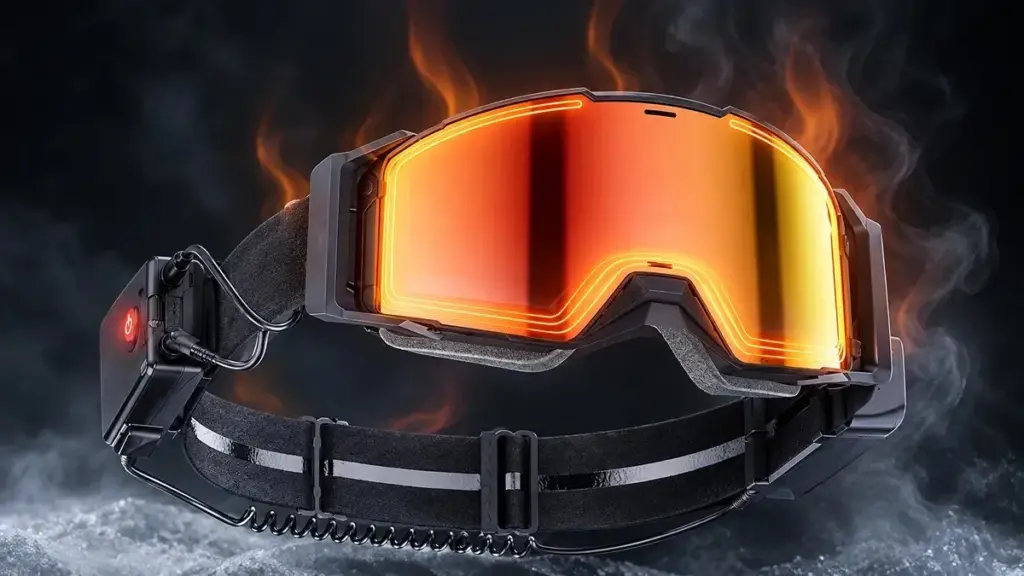
The HB-60 from Hubo Sports takes a different approach. Instead of waiting for airflow to fix the problem, it heats the lens. A sensor watches temperature and humidity inside the goggle cavity, and a control board drives a heating film before condensation forms. Around that core sit a wide cylindrical lens, a magnetic two-piece lens system, and a sealed ergonomic frame.
Product Overview
Specifications at a Glance
| Item | Spec |
|---|---|
| Battery type | 18500 low-temperature lithium, 3.7V |
| Capacity | 2000 mAh / 7.4 Wh |
| Output | DC 7.4V ± 0.2V |
| Current | < 3 A |
| Runtime | 5–12 hours per charge |
| Charge time | Approx. 2.5 hours |
| Charge input | 5V / 2A (1000mA constant current recommended) |
| Charge ports | USB-A, USB-C, car USB |
| Operating temperature | -20°C to 60°C |
| Defog response | 3–5 seconds |
| Lens type | Large cylindrical, zero-distortion optical |
| Field of view gain | +15% vertical, +20% horizontal |
Component Breakdown
The HB-60 is not a lens with a wire taped to it. The build breaks down into eight functional parts.
| Outer magnetic lens | Removable tinted layer, multi-point magnetic mount |
| Inner heated anti-fog lens | Heating film bonded to the inner lens surface |
| Temperature & humidity sensor | Reads conditions inside the goggle cavity in real time |
| Control board | Converts sensor data into PWM heating output |
| Built-in battery compartment | Sealed 18500 cell, no external pack |
| Silicone seal | Blocks wind and snow at the face contact line |
| Touch switch | Power and battery-level control |
| LED indicators | Four red LEDs showing charge state |
Active Electric Defogging
This is the part that separates the HB-60 from goggles that just add more vent holes.
How the System Works
The sensor and processor monitor the goggle cavity continuously. When cavity temperature moves through the -15°C to 5°C band, or the dew point crosses the preset trigger value, the control module starts sending PWM pulses to the heating film. Pulse timing is adjusted to hold a steady surface temperature rather than dumping heat and draining the battery.
Existing fog clears in 3 to 5 seconds, but the more useful behaviour is that the system usually catches the problem before fog forms at all. Passive ventilation can only slow condensation down. Heat removes it.
Operating Environments
| Environment | Temperature range | Behaviour |
|---|---|---|
| Ski resort, general riding | -12°C to 2°C | Primary operating range |
| Professional competition | -10°C to -15°C | Primary operating range |
| Extreme cold | Below -25°C | Heated defog assist |
Sleep Behaviour During Charging
One detail worth knowing: the goggles sleep while charging. The sensor stops reading and the heater stays off, so you cannot run the defogger off a power bank mid-run. Charge before you ride.
Power and Charging
Operation is a single touch switch.
| Action | Input | Result |
|---|---|---|
| Power on | Short press | 4 LEDs show charge level for 5 seconds, then auto mode starts |
| Power off | Long press, 3 seconds | System shuts down |
| Check battery | Short press during use | LEDs display for 5 seconds |
LED Charge Indicators
The four LEDs map to actual cell voltage rather than a guessed percentage.
| Indicator | Charge level | Cell voltage |
|---|---|---|
| LED1 | 100% (full) | 4.1 V |
| LED2 | 75% | 3.6 V |
| LED3 | 50% | 3.1 V |
| LED4 | 25% (low, charge soon) | 2.7 V |
While charging, the LED matching the current level blinks. All LEDs go dark once the cell is full, which is a deliberate power-saving choice rather than a fault.
Battery Health Rules
Do Not Charge Below 0°C
Move the goggles somewhere warm and let them sit for an hour before plugging in. Charging a lithium cell below freezing causes lithium plating on the anode, and that damage does not reverse.
Charge When LED4 Lights Up
Running an 18500 cell flat repeatedly shortens its service life. LED4 is the warning, not the deadline.
Remove the Port Cover Before Plugging In
Forcing a connector against the USB-C protective cover will damage the port. Peel it back first.
Optics and Lens System
Wide Cylindrical Lens
Flat, narrow lenses cut off more of your view than most people realize. The HB-60 uses a deeply curved cylindrical optical lens that opens the field of view by 15% vertically and 20% horizontally.
Vertical Range on Steep Terrain
You can read the snow ahead of you on a fast descent without dropping your chin. That sounds minor until you are carrying speed into a rollover and need to see the landing.
Peripheral Coverage
A rock, a tree, or a rider coming across your line shows up in peripheral vision instead of appearing out of nowhere. Most collisions on a crowded run start as something you never saw.
Coating and Contrast
The lens is tuned for zero distortion and carries a spectral filtering coating. That coating cuts the scattered glare bouncing off snow and lifts contrast, so flat light stops hiding the things you need to see: dips, ice patches, exposed roots.
Magnetic Dual-Layer Lenses
The outer lens is held on by multi-point magnets. No tools, no clips to pry.
Removal Procedure
Removal takes about three seconds once you know the motion. Hold the frame in one hand and the lens edge in the other, hook your thumb into the grip notch on the lower edge, and push outward. The bottom edge releases first. Then lever the whole lens away from the frame.
Why Replaceable Lenses Save Money
Scratch a one-piece goggle and the whole thing is finished. Scratch the HB-60 and you replace one outer lens. Over two or three seasons that difference adds up, especially for anyone putting the goggles through daily use. Splitting the layers also means you can actually clean between them when snow or moisture works its way in, instead of watching a permanent haze build up.
Retention Under Impact
The magnetic mount uses a double-lock design. It pulls itself into alignment when you bring the lens close, then stays put through chatter, hard landings, and face-first crashes into deep snow.
Tint Options
| Tint | Category | Best for |
|---|---|---|
| S0 | Clear, brightness boost | Night riding, heavy snowfall, flat light |
| S2 | Contrast | Overcast and variable cloud |
| S3 | Revo mirror | Bright sun, high-altitude glare |
One frame, one strap, three lenses in a jacket pocket.
Fit and Wearing Comfort
Sealing and Foam Layers
Three layers of high-density breathable foam line the frame, backed by a silicone seal. The foam follows the shape of your face and keeps wind and loose snow out of the goggle cavity, which is what causes cold, dry, watering eyes after a few hours. The foam also breathes, venting moisture outward while the heater works from the inside.
Strap and Quick-Release Buckles
The strap runs through quick-release buckles on both sides.
Strap Removal
Press the lock buckle on the frame edge with a finger, hold the strap, and pull it free. Same motion on the other side.
Adjustment and Grip
Wavy silicone grip on the strap face keeps it from sliding on a helmet shell, and length adjusts to any head size in about a second, gloves on.
Compatibilité du casque
Frame geometry is cut for helmet compatibility. No gap across the forehead, no lifted edges, no cold air funneling in through a gap you cannot see. The whole module is light enough that it does not press on the nose bridge or temples after six hours. There are no sharp edges anywhere on the frame, which is worth something the first time you go down hard.
Care, Troubleshooting, and Sourcing
Maintenance Habits
Clean After Every Session
Wipe the lens down after riding. Meltwater left sitting on the inner lens will corrode the heating film over time.
Monthly Off-Season Charge
Charge once a month during storage to keep the cell active. A lithium battery left flat for a season may not come back.
Storage Conditions
Store dry. Avoid hard impacts and never submerge the goggles.
Troubleshooting
| Symptom | Likely cause and fix |
|---|---|
| LEDs do not blink while charging | Loose USB-C connection, or ambient temperature below 0°C. Reseat the cable and warm the goggles up. |
| Heating film does not activate after power-on | The dew point trigger has not been reached. Check that the indicator light is on, then breathe onto the sensor probe to raise humidity and confirm the heater engages. |
| Runtime falls short of 5 hours | Usually caused by extreme cold or repeated power cycling. Leave the system running continuously instead of toggling it. |
Materials and Compliance
No PFAS or similar harmful chemicals are intentionally added to any material in the HB-60 line. The goggles meet European and North American environmental testing standards for outdoor equipment, which makes them straightforward to move through cross-border trade and retail buying programs.
Customization and Wholesale
Logo customization is available on both the strap and the frame. Modularity also helps on the sustainability side: lens, strap, and battery are all replaceable on their own, so a single failed part does not send a whole goggle to landfill.
Application Range
Use cases run across the full range of snow sports: alpine skiing, park snowboarding, ski mountaineering, and snowmobiling. Recreational riders and racers both fit within the adjustment range.
Four problems have followed ski goggles for years. Fogging. Restricted vision. Expensive lens replacement. Fit that gets uncomfortable by lunchtime. The HB-60 answers all four with active heating and a magnetic modular build, and it keeps your view clear when the temperature drops.