Skiing and snowboarding are sports that exist in the extreme. You are operating at the intersection of high-intensity physical output and freezing environmental conditions. As you carve down a double-black diamond or hike a back-country ridge, your body is essentially a furnace, pumping out heat and moisture at a rapid rate. Meanwhile, the air outside is biting cold, often hovering well below the freezing point.
This temperature differential is the primary catalyst for one of the most frustrating experiences in winter sports: goggle fog. One moment you are enjoying a panoramic view of the Alps, and the next, you are staring into a thick, white wall of condensation. To the uninitiated, fog seems like an inevitable nuisance. But to engineers, it is a problem of thermodynamics and fluid dynamics.
In this deep dive, we’re going to look past the mirrored coatings and the sleek frames to understand the hidden engineering that allows a ski lens to ‘breathe.’ We’ll explore the science of dual-pane insulation, the ‘chimney effect’ of frame ventilation, and the molecular chemistry of anti-fog coatings that keep your vision crystal clear even when the conditions are working against you.
Why Vision Fails?
To solve the problem of fog, we first have to understand what it actually is. Fog on a goggle lens is simply water vapor that has undergone a phase change back into liquid. Your face constantly releases moisture—through sweat and even through the simple act of breathing. This moisture is warm and trapped in the small space between your face and the lens.
When this warm, humid air comes into contact with a cold surface—the lens chilled by the external mountain air—it loses its ability to hold water in a gaseous state. This point is known as the ‘Dew Point.’ The water molecules slow down, cluster together, and form tiny droplets. Because these droplets are spherical, they scatter light in every direction, which is what gives fog its opaque, white appearance.
If you use a basic, single-pane lens, the temperature transfer is immediate. The plastic is thin, and the cold from the outside travels directly to the inner surface, making condensation almost guaranteed during high exertion. Premium engineering focuses on interrupting this thermal transfer at three distinct levels: insulation, circulation, and absorption.
The Thermal Buffer (Dual Layer Engineering)
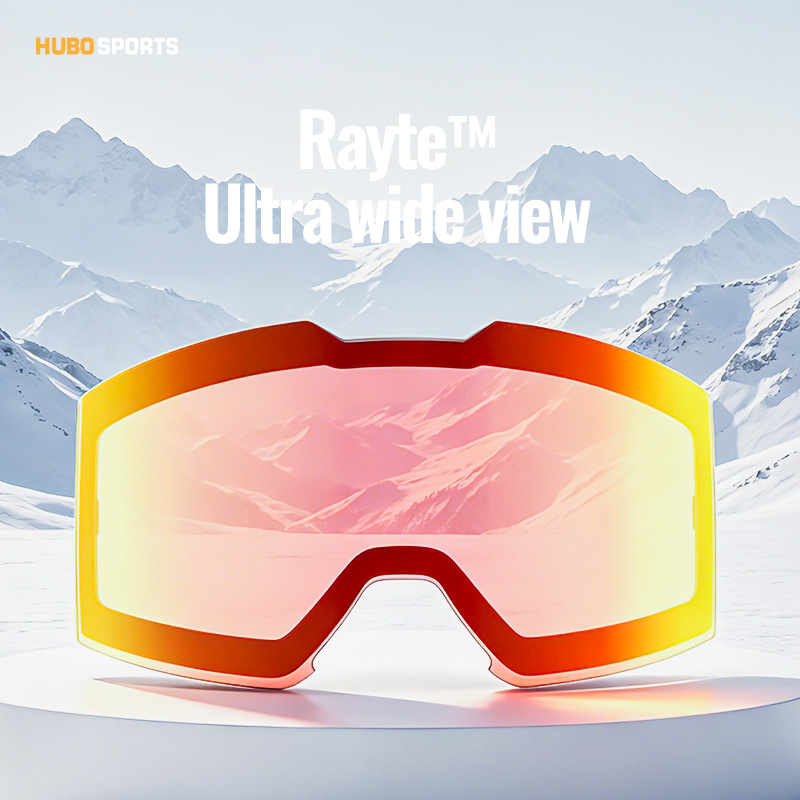
The most important technological leap in goggle history was the introduction of the dual-pane lens. Think of it as double-glazing for your face. Instead of one sheet of polycarbonate, a lens consists of an outer lens and an inner lens, bonded together with a gasket (usually made of a specialized foam or rubber).
Between these two lenses is a thin layer of trapped air. Because air is a poor conductor of heat, this pocket acts as a powerful insulator. The outer lens can be freezing cold, but the inner lens remains much closer to your body temperature. By keeping the inner surface warm, engineers significantly push the dew point further away, preventing the moisture inside from ever reaching the temperature needed to turn back into liquid. This is the foundation of all high-performance anti-fog systems.
However, the quality of this dual-pane system varies. In budget goggles, the seal can leak, allowing moisture to get *between* the lenses—a nightmare scenario where the fog is impossible to wipe away. At HUBO, we use a military-grade adhesive seal to ensure that the air gap remains hermetically sealed, maintaining the vacuum-like insulation properties for the life of the product.
The Chimney Effect (Aerodynamic Ventilation)
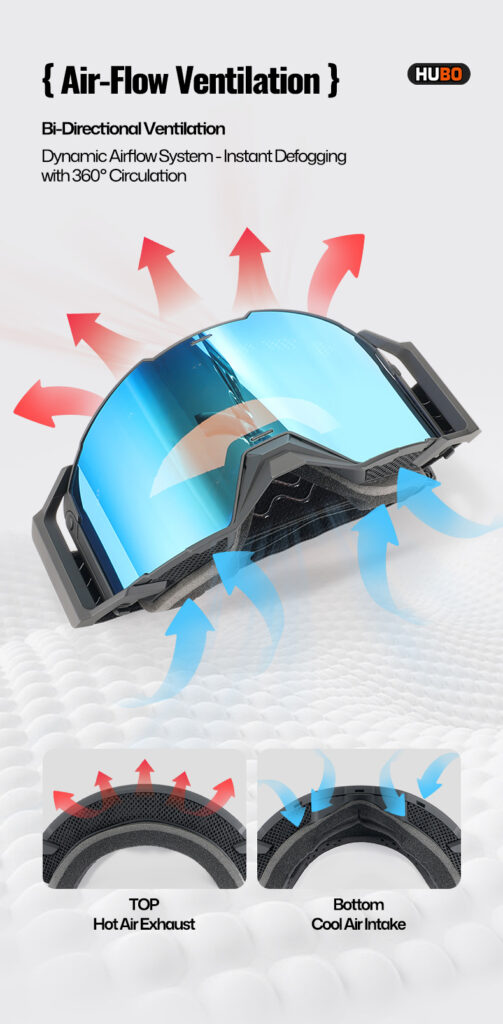
Even with perfect insulation, moisture will build up if it has nowhere to go. This is where frame ventilation comes into play. If insulation is the ‘passive’ defense, ventilation is the ‘active’ defense. Engineers utilize the ‘Chimney Effect’—the natural tendency of hot air to rise.
Strategic ports are built into the top and bottom of the goggle frame. As you ski or snowboard, air flows over the goggles, creating a pressure differential. Cool air is sucked into the bottom vents, while the warm, moist air rising from your face is pulled out through the top vents. This constant cycle of air exchange ensures that the humidity level inside the goggles never reaches a critical saturation point.
The challenge for designers is ‘regulating’ this flow. If the vents are too open, the goggles will feel drafty and your eyes will water. If they are too closed, the ‘breathing’ stops. Our frames use a specialized breathable foam over the vents. This material acts as a regulator: it allows air molecules to pass freely while blocking larger snow particles and diffusing the wind to prevent discomfort. It’s a delicate balance of aerodynamics and material science that separates pro gear from entry-level equipment.
Hydrophilic Chemistry (Molecular Coatings)
Sometimes, the physical and aerodynamic systems aren’t enough—such as when you’re standing still in a lift line or hiking through heavy, wet snow. For these moments, we turn to chemistry. The inner surface of premium lenses is treated with a ‘hydrophilic’ (water-loving) coating.
Standard plastic is hydrophobic, meaning water beads up on it. Those beads are the droplets that create fog. A hydrophilic coating works by lowering the surface tension of water. Instead of forming tiny light-scattering droplets, the moisture is forced to spread out into a flat, uniform film across the lens. This film is completely transparent, allowing light to pass through without distortion. The moisture is still there, but because it’s a flat sheet rather than a billion tiny spheres, it is invisible to your eyes.
Warning: This coating is delicate. Many skiers make the mistake of wiping the inside of their goggles with a rough paper towel or a dirty glove when they see moisture. This friction can scratch or even remove the hydrophilic layer entirely, rendering the anti-fog technology useless. Always use a microfiber bag and ‘dab’ rather than wipe.
The Importance of Fit and Foam
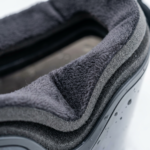
Engineering can be perfect, but it will fail if the ‘seal’ on your face is broken. If there is a gap around your nose, the warm air you exhale will travel directly into the bottom vents of your goggles, overwhelming the system instantly. This is why the ‘face foam’ is more than just a comfort feature.
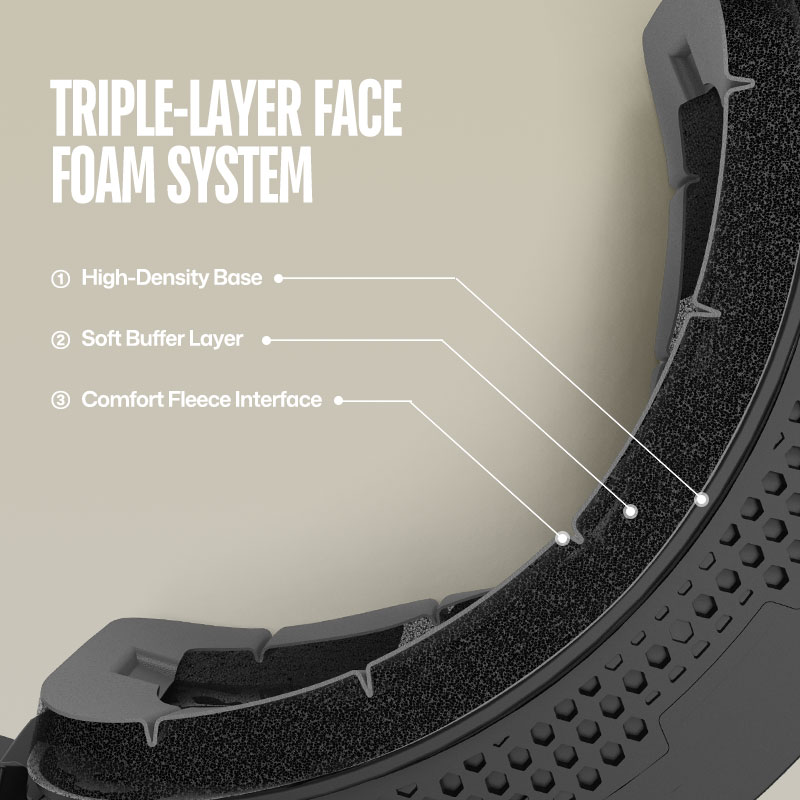
SNOWLEDGE goggles feature triple-layer face foam. The first layer is a dense, structural foam that maintains the frame’s shape. The second is a softer, breathable layer that absorbs shock and moisture. The final layer is a hypoallergenic fleece that sits against your skin, providing a moisture-wicking seal that prevents external breath from leaking into the goggle chamber. A good fit is the invisible hero of anti-fog technology.
How to Protect Your Vision
Even the best-engineered goggles need proper care to maintain their ‘breathing’ ability. Here are three professional tips to ensure your anti-fog tech lasts for seasons:
1. Air Them Out: After a long day of skiing, never leave your goggles in the storage bag while they are still wet. The trapped moisture can soak into the foam and eventually compromise the anti-fog coating. Let them air dry in a room-temperature environment (away from direct heaters).
2. Watch Your Balaclava: One of the most common causes of fogging is tucking your face mask under the bottom foam of the goggles. This directs your breath straight into the lens chamber. Keep your mask just below the goggle frame to allow your breath to escape externally.
3. Clear the Vents: If you take a tumble in deep powder, snow can clog the top ventilation ports. This effectively ‘suffocates’ the goggles, stopping the chimney effect. Always brush the snow off your frames after a fall to restart the air circulation.
Vision Without Limits
The next time you’re standing at the edge of a run, take a second to look at the gear you’re wearing. It’s more than just fashion. It’s a sophisticated network of thermal barriers, aerodynamic channels, and molecular chemistry. By understanding how your goggles ‘breathe,’ you can make better decisions about fit, maintenance, and gear selection.
Don’t let fog define your day on the slopes. Choose gear that is engineered for the elements, and let your lenses breathe. Stay clear, stay safe, and enjoy every carve.