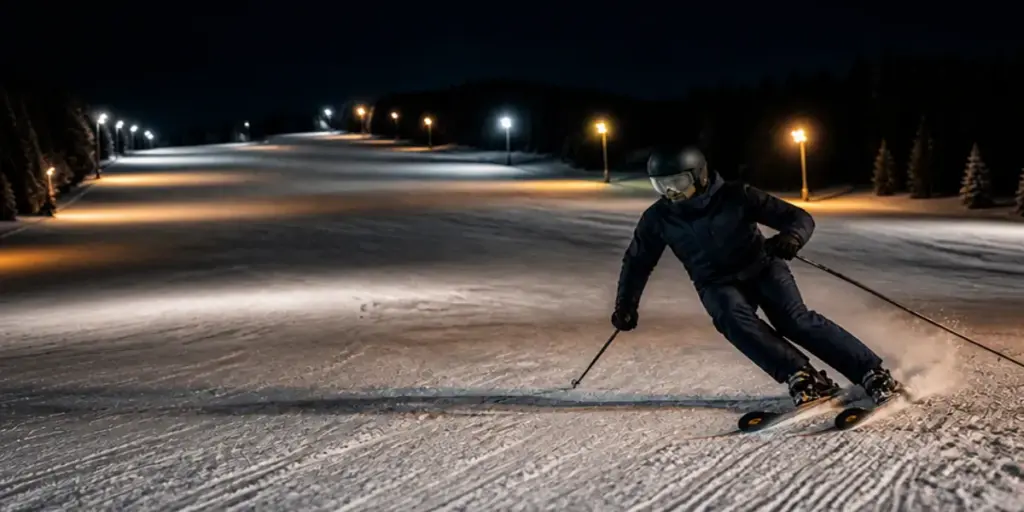
Once the sun drops and the resort lights come on, the run changes character. There is no direct sunlight and no bright snow reflection to work with — just pools of yellow sodium light, patches of cold white LED, and deep shadow cut in between. A daytime lens admits too little light for that. It does not merely underperform; it leaves you skiing half blind. This guide covers the optics of a floodlit slope and how to choose a lens that fits it.
The optical problem with night skiing
Artificial light is a compromised spectrum
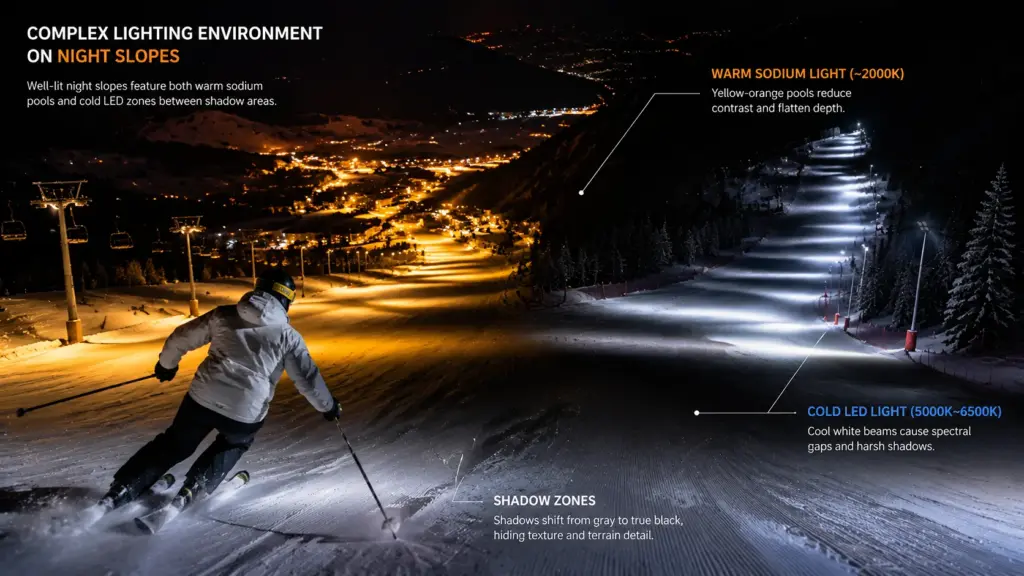
Sunlight arrives as a full continuous spectrum. Resort lighting does not. High-pressure sodium skews yellow-orange, LED skews cool white, and both are spectrally discontinuous. Your eyes are asked to judge distance and texture from distorted colour information, and contrast and depth perception drop sharply as a result. Add a dark tint on top and the shadow zones go from dim to genuinely black.
The zebra-stripe effect
Resort lamps cast light in cones, so the run between two posts alternates bright, dark, bright, dark. Ski that at speed and your pupils are dilating and constricting continuously. It is a real adaptation load, and the lag it introduces runs into milliseconds — about the margin you need to spot the slow skier ahead of you.
The fogging paradox
Resort lamps cast light in cones, so the run between two posts alternates bright, dark, bright, dark. Ski that at speed and your pupils are dilating and constricting continuously. It is a real adaptation load, and the lag it introduces runs into milliseconds — about the margin you need to spot the slow skier ahead of you.
Lens specifications that actually matter
Ultra-high VLT: let every photon in
The first job of a night lens is Visible Light Transmission. You want 60% to 90% VLT — a long way from the 10% to 20% you would run in daylight. Clear, light yellow and light rose all sit in that range. They block almost nothing and still give you a mild contrast lift.
Yellow lenses, the classic pick
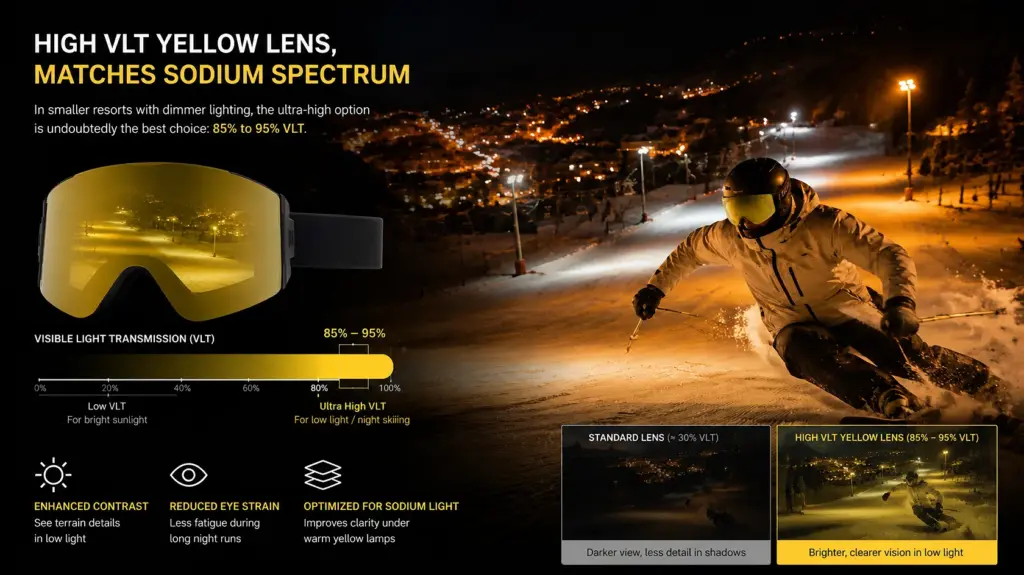
Yellow stays the night skier’s favourite for a reason. It selectively filters part of the scattered blue noise coming off sodium lamps, and the yellow band itself lines up with the sodium spectrum. You get better snow texture recognition without giving up brightness — effectively a contrast filter that lets your brain read terrain faster.
Clear lenses, the maximum-light compromise
At a small resort with weak lighting, clear is the extreme option: 85% to 95% VLT. You keep every lumen of what little illumination exists. The trade is that you get no contrast enhancement whatsoever. That is a reasonable deal for slow or beginner night skiing, where reaction time is less critical.
Why anti-fog is a different problem after dark
Higher fogging pressure
The wider temperature differential is the main accelerator. Night sessions are also short, usually 2 to 3 hours, which pushes skiers to ride continuously at higher intensity and concentrate facial heat output. Hubo Sports’ night-oriented goggles increase both top and bottom vent area to handle that humidity load.
Double-lens thermal barriers
Since any fogging is amplified at night, physical prevention becomes the baseline rather than a bonus. The sealed air layer between dual-pane lenses is the last physical defence, delaying inner-lens cooling by 3 to 5 seconds. At speed, those seconds decide whether you catch a critical visual cue or ride past it.
What not to wear: three night traps
Polarized lenses are dangerous at night
Polarization is excellent at killing daytime glare off snow and ice. After dark it works against you: the polarizing molecular layer strips out roughly 30% to 40% of usable light, in an environment that is already short on lumens. If polarized is all you own, swap to a non-polarized high-transmission lens before the night session.
Dark REVO mirror coatings
The aggressive mirror coatings that look superb under sun act like blindfolds under floodlights. They cut light intake by reflection, and at night there is no abundant natural light to reflect — so they simply reject the scarce artificial light you actually need.
The photochromic delay trap
Photochromic lenses need UV to trigger, and there is effectively no UV at night. The lens may never reach full transmission, leaving you stuck at a medium VLT that is still too dark to ride. Do not assume a daytime photochromic lens goes clear enough once the lights come on. It usually does not.
Pre-session checklist
Confirm lens transparency
Hold the goggles up under indoor lighting and look through them. Can you see your own eyes clearly? If not, the VLT is too low and that lens does not belong on a night run.
Verify lens cleanliness
Clear off grease, fingerprints and residue before you ride. These are invisible in daylight. At night they scatter artificial light into halos, which is exactly when you need to judge an obstacle ahead.
Test headlamp compatibility
Running a helmet-mounted lamp? Check that it does not throw internal reflections inside the goggle chamber. A badly angled lamp bounces light off the inner lens surface straight back at your eyes, and you end up seeing less, not more.
Make the night your home turf
Night skiing is not day skiing with the lights on
The night slope runs on different physical rules, which is why it needs its own equipment strategy rather than a leftover daytime setup. Fit a high-VLT lens built for low light and the run stops being a compromise. Hubo Sports carries a full range of night-ready lenses, from clear through light yellow.