Tree skiing is a favorite terrain for many skiers: deep powder, free lines, and full of challenge. But if you pay attention, you will notice a unique visual experience in the trees – sunlight flickering through branches, light and dark alternating rapidly, like a fast-flashing slide show.
Ski for long and your eyes feel strained and your reactions slow. This is not an illusion; it is a real test of the visual system. This article explains, from the visual mechanism, what your eyes go through in the trees and how the right goggles can reduce the burden.
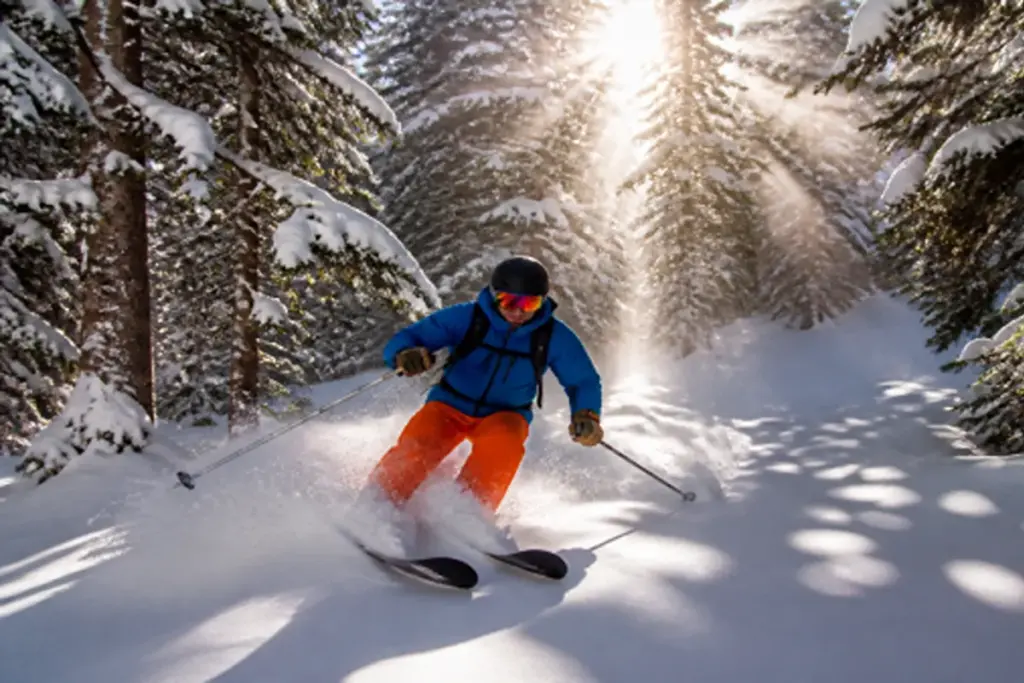
Sunlight sliced by the canopy: dappled light and shadow define the unique visual world of tree skiing
The Flicker Effect: The Truth Behind the Flickering Light in the Trees
Tree Gaps Cut Sunlight Into “Intermittent Light”
When you move quickly through trees, trunks and branches continuously slice the sunlight, turning the light reaching your eyes into a high-frequency sequence of light-dark alternation – this is the Flicker Effect. Unlike indoor light flicker, the amplitude in the forest is extreme: the brightness difference between the two states can be several times, and the frequency changes with your speed, ranging from a few hertz to over a dozen hertz.
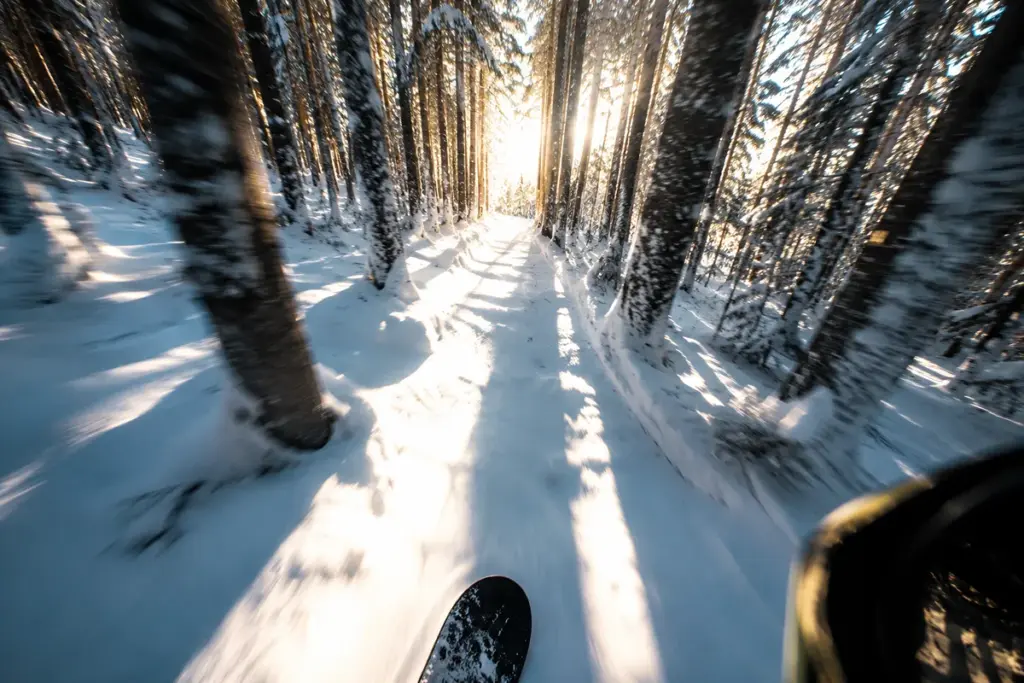
High-frequency light-dark alternation: trunks and branches slice sunlight into a fast-flashing rhythm
The Visual System Works Overtime
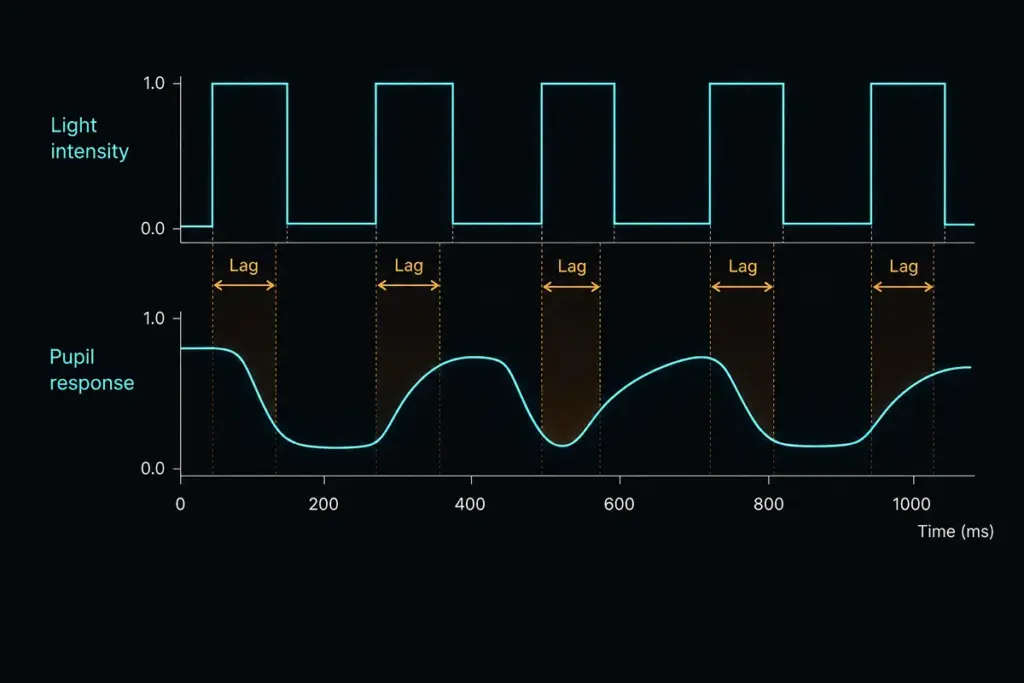
The human pupil takes from tens to hundreds of milliseconds to adjust – it cannot keep up with the flicker rhythm in the trees. The retina and visual cortex are forced to continuously process large brightness jumps, requiring extra energy to “stabilize” the image.
The result: visual fatigue arrives early, scanning speed drops, and reaction time to suddenly appearing obstacles lengthens – in a terrain where you need to dodge trees quickly, this directly affects safety.
Why Some People Feel It “Particularly Badly”
Sensitivity to flicker varies by individual: some people adapt naturally, while others experience obvious dizziness and eye strain. The stronger the light and the greater the light-dark contrast, the more intense the flicker stimulus – bright sunny midday in sparse forest is the worst combination for flicker.
Light Transitions: The “Dual-Light-Zone” Challenge in the Forest
Brightness Between Shade and Open Areas Can Differ Several Times
Tree-skiing routes often switch rapidly between shaded areas and open terrain. The same pair of goggles must “work” across two brightness environments, which places high demands on the lens’s dynamic adaptability.
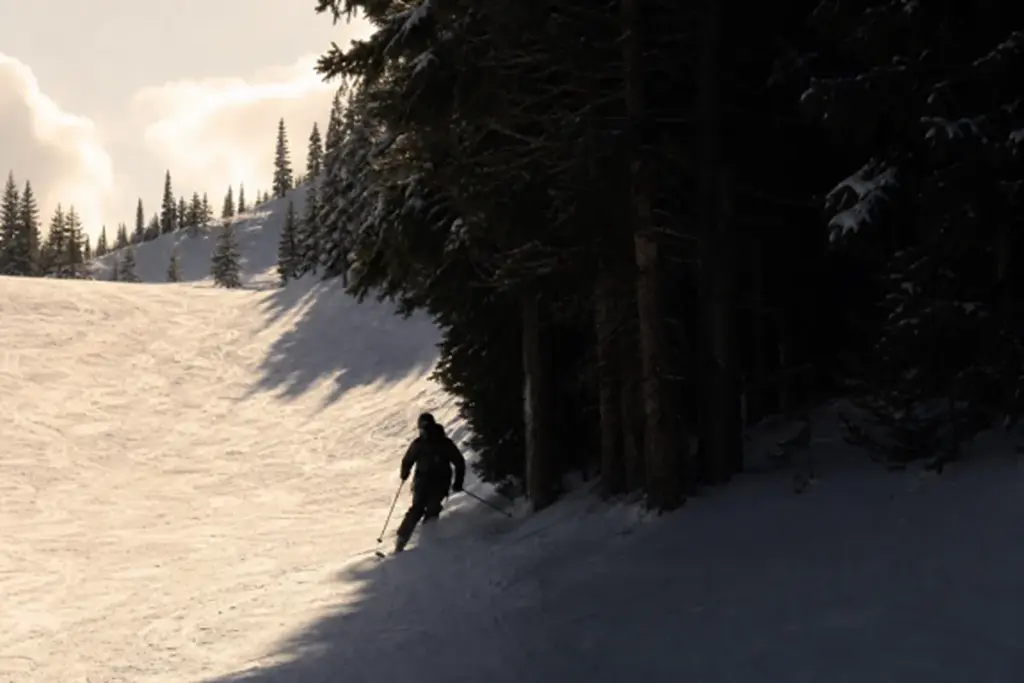
Dual-light-zone challenge: the brightness gap between open slope and deep shade can be several times
The Hidden Danger of Dark Lenses: “Can’t See” the Moment You Enter Shade
If you are wearing a lens with VLT below 25% and dive into the trees, the moment you enter the shade, your visibility drops below the safe threshold. Details of moguls, roots, and gullies all disappear, and you ski by “feel” alone – a leading cause of tree-skiing crashes.
The Limits of Photochromic Lenses: Transition Speed Can’t Keep Up
Photochromic lenses seem like the perfect answer for the forest, but their transition takes seconds to tens of seconds, and is even slower in cold. When you move frequently between shade and sun, the lens is always “one step behind” – either too light in the open or too dark in the shade.
Conclusion: for tree skiing, a fixed mid-range VLT lens is more reliable than relying on photochromic.
Peripheral Vision: Dodging Trees Depends on Your “Side Vision”
Danger in the Forest Comes From the Edge of Your Vision
Unlike groomed runs, obstacles in the forest – trunks, fallen logs, low branches – often appear at the edge of your field of view. This means peripheral vision matters more than central vision in the trees: your side vision first detects movement and shapes, then your gaze shifts to confirm.
Lens Shape Determines Field Width
Spherical lenses curve closer to the natural curvature of the human eye and deliver a wider horizontal and vertical field of view than cylindrical lenses, with less edge distortion. Skiers who spend a lot of time in the trees should prioritize spherical or toric designs to reduce the “tunnel” feeling.
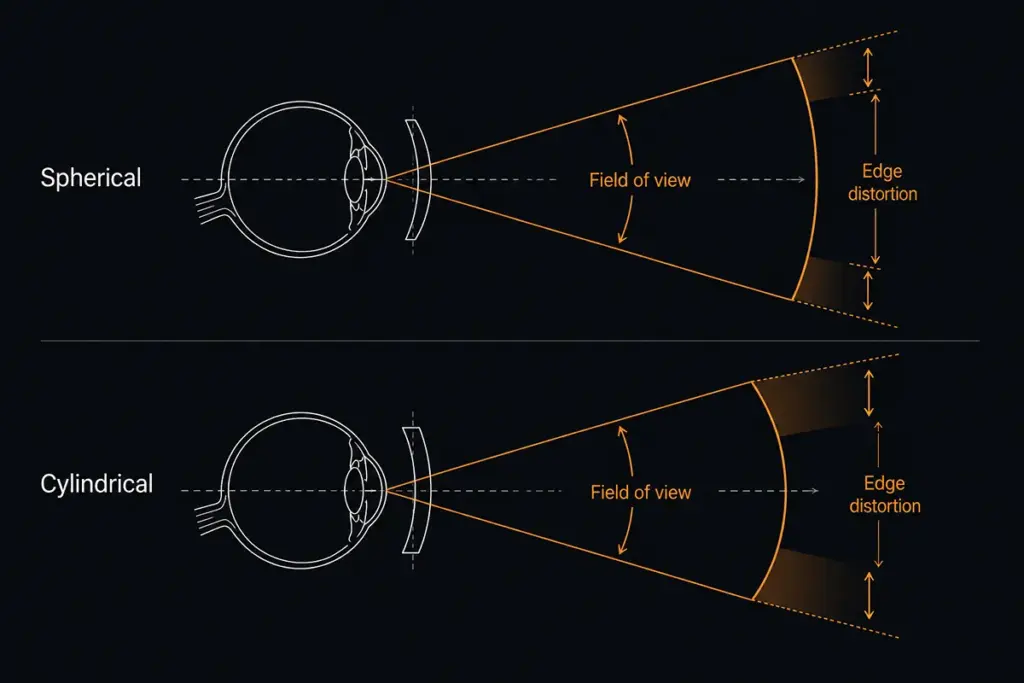
Spherical lens shape: closer to the eye’s natural curve, with a wider field and less edge distortion
Frameless and Oversized Frames: The “Physical Boundary” of Vision
Frameless construction extends the usable field by reducing frame obstruction of the view. The narrower the frame and the larger the lens, the more information your peripheral vision can capture – a real safety gain in the forest.
Lens Pairing Recommendations for Tree Skiing
Choose a Mid-Range VLT: 40%-60%
The ideal lens for the forest is a mid-to-high VLT contrast-enhancing tint: rose or amber. They keep enough brightness in the shade while enhancing snow texture contrast through the tint, helping you read the terrain.
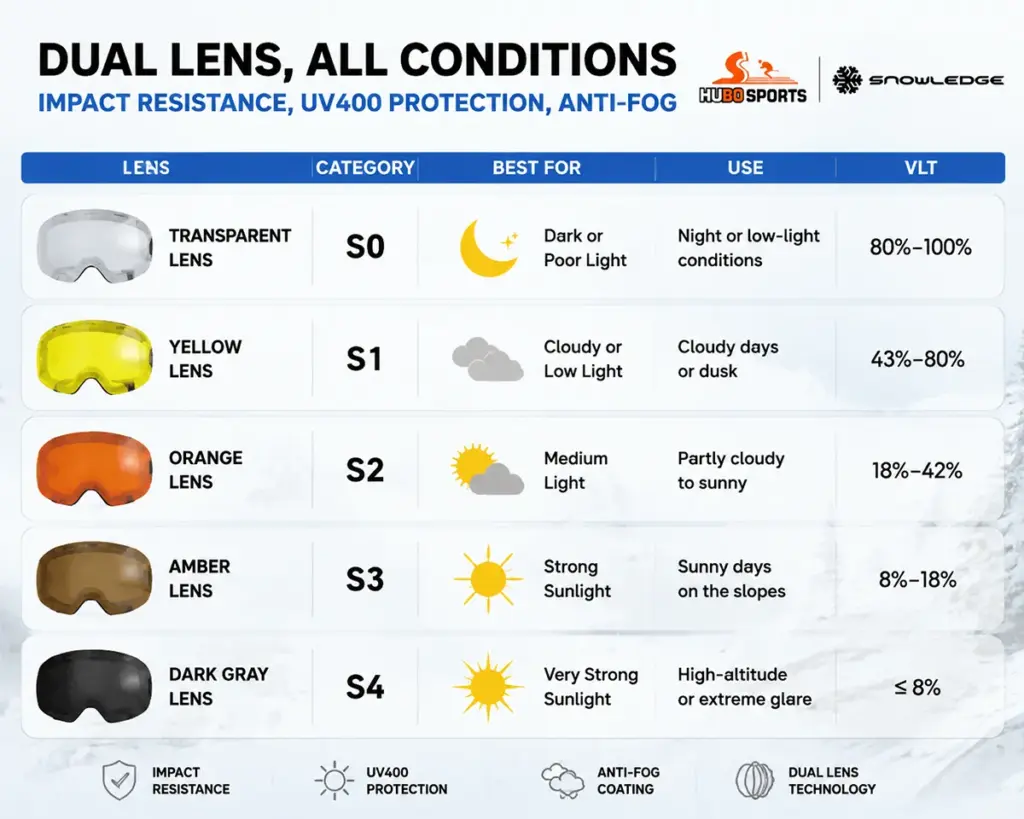
Mid-range VLT amber lens: bright enough in the shade, contrast-rich in the open
Contrast Beats “Looking Bright”
What you really need in the trees is not “brighter” but clearer light-dark layering. Contrast-enhancing coatings that sharpen the fine texture of the snow surface help you read the terrain more than simply boosting light transmission.
Practical Checklist: Spare Lens + Avoid Dark Mirrors
- Carry a spare lens: on sunny days the brightness gap between shade and open terrain is even larger, and being able to swap lenses quickly is the safest option.
- Avoid dark mirror coatings: the mirror reflection further reduces light entering in the shade.
- Prioritize spherical/frameless designs: leave more room for peripheral vision.
Conclusion: Prepare for “Invisible Fatigue”
Keywords for Tree-Skiing Goggles
- VLT 40%-60%
- Contrast-enhancing tint
- Spherical/toric design
- Quick lens swap
Remember four keywords: VLT 40%-60%, contrast-enhancing tint, spherical/toric design, and quick lens swap. Flicker and light transitions cannot be eliminated, but the right lens can significantly reduce the burden on your visual system, making your eyes more “durable.”
Be Ready for Varied Terrain
Hubo Sports’ spherical contrast-enhancing lenses and side-lock magnetic quick-change system are designed for fast visual transitions across varied terrain – whether in powder-day tree runs or sunny tree-line descents, you can switch to the most suitable vision solution in two or three seconds.
Side-lock magnetic quick-change: swap to the right lens in two or three seconds
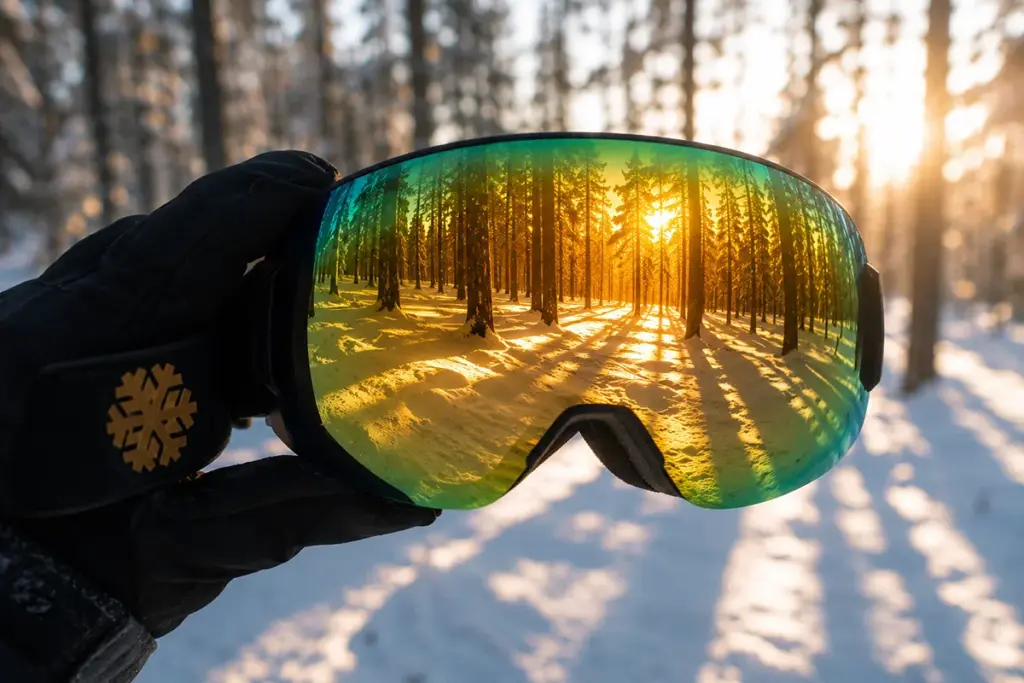
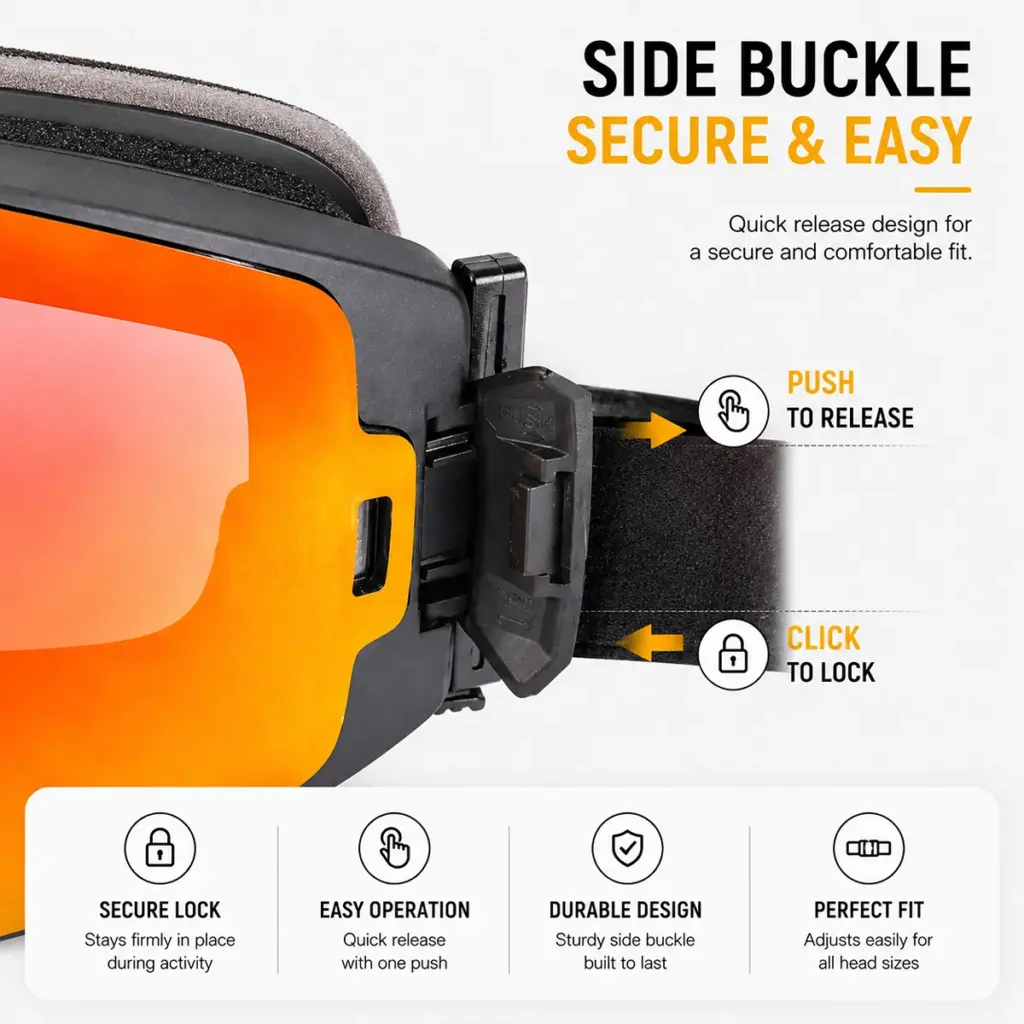
With the right lens, flicker and light transitions lose their sting – your eyes stay durable in the trees