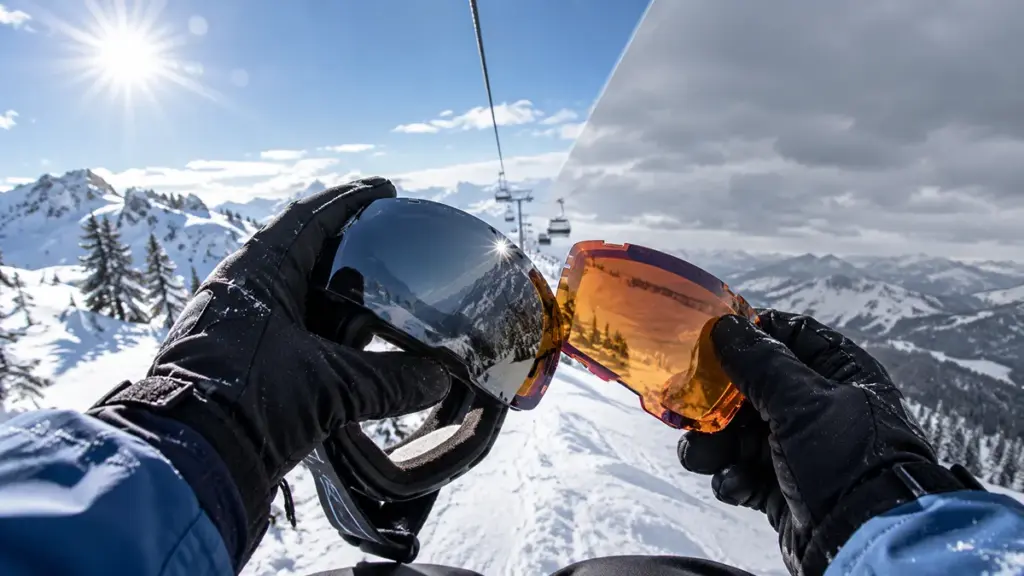
You’re standing at the top of the lift, and the forecast lied again. The morning sun is brutal off the fresh snow, but there’s a cloud bank rolling over the ridge that will flatten the light by noon. Your buddy squints through a near-black mirror lens while you dig a second lens out of your pocket. One number separates a good day from a whiteout: VLT.
What Does VLT Actually Mean?
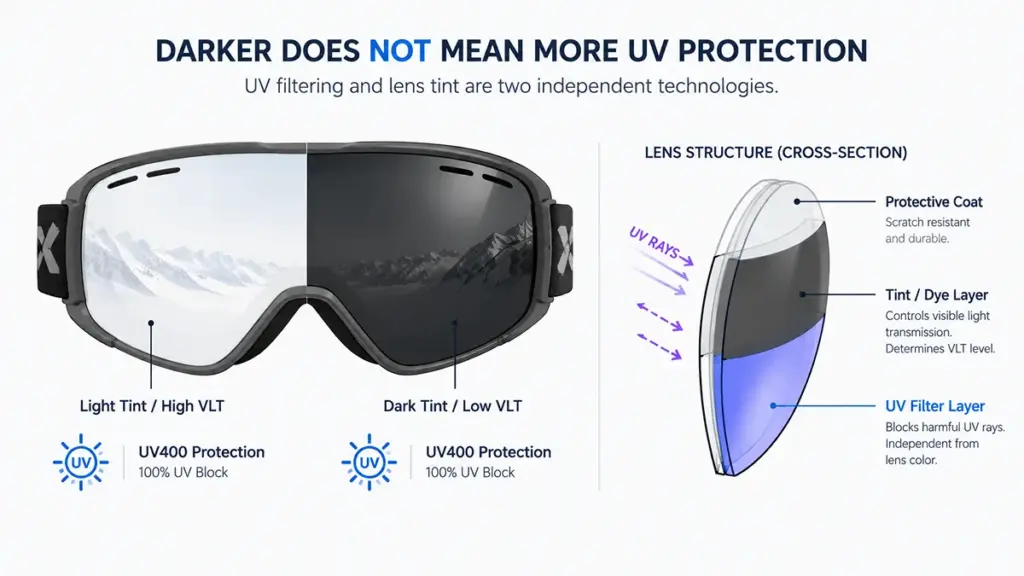
VLT stands for Visible Light Transmission, the percentage of visible light that passes through the lens and reaches your eye.
- 100% VLT is a clear lens, like a window.
- 0% VLT is opaque: nothing gets through.
- あ lower VLT means a darker lens that blocks more light.
VLT has nothing to do with UV protection. UV blocking comes from a separate filter in the lens material, not from the tint: a near-clear lens can block 100% of UV while a dark one blocks none. That’s why you check the VLT number instead of just reaching for whatever looks darkest.
The S0 to S4 Filter Scale
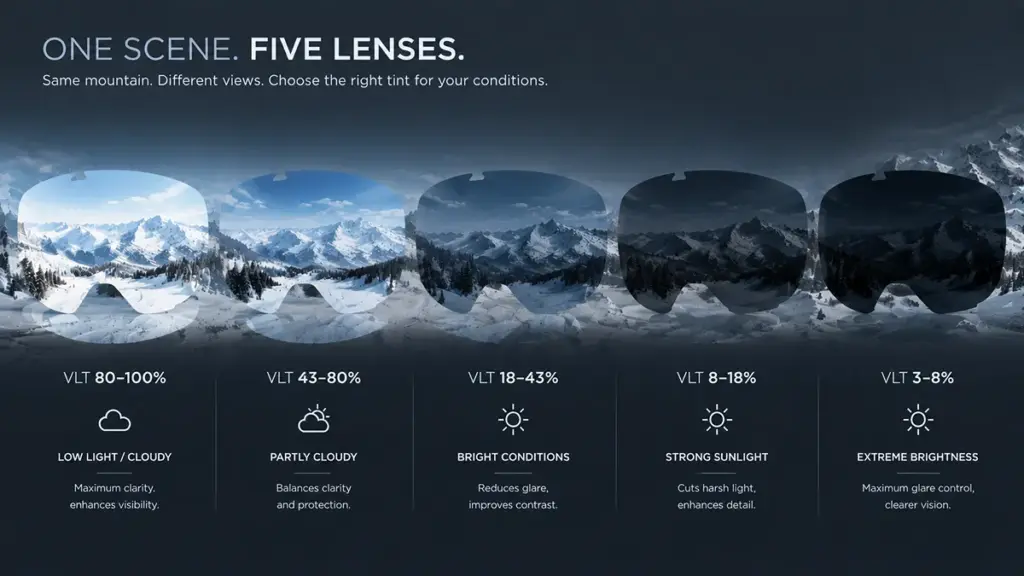
Filter categories sort goggle and sunglass lenses by how much light they let through. The scale runs from S0 to S4:
| Category | VLT range | What it’s for |
| S0 | 80–100% | Night skiing and very low light — nearly clear |
| S1 | 43–80% | Overcast and low-light days — light tint |
| S2 | 18–43% | Mixed and changeable conditions — medium tint |
| S3 | 8–18% | Bright sun — the classic sunny-day lens |
| S4 | 3–8% | High altitude, glacier and extreme glare — very dark |
Darker is not automatically better. The right lens is the one that matches the light you’re actually skiing in.
Matching VLT to the Conditions
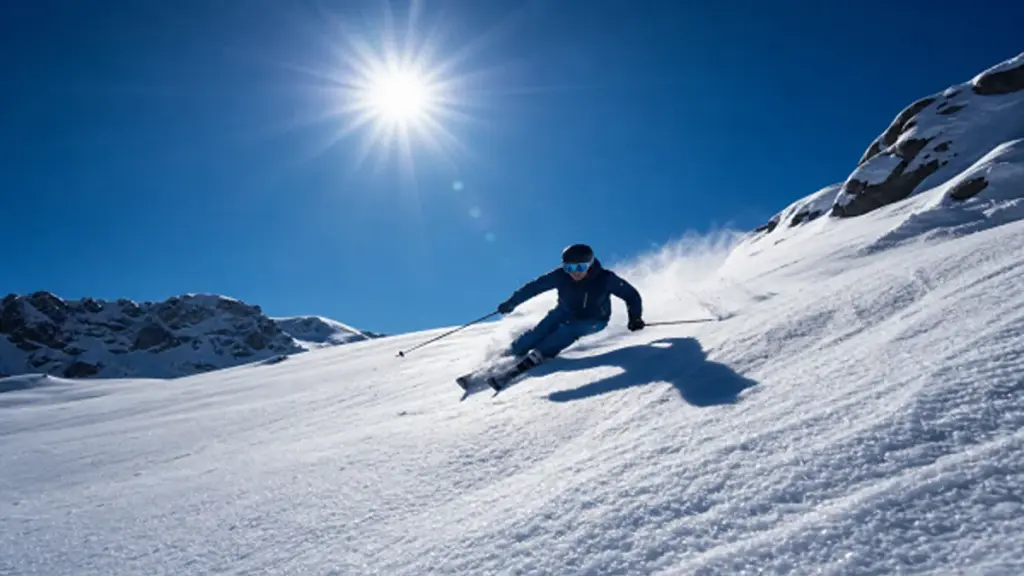
On a bluebird day the snow acts like a mirror, throwing sunlight back at you from every direction, and the glare gets uncomfortable fast. This is the job for a low-VLT lens, something in the S3 range, around 8–18%. A dark lens cuts the glare and lets your eyes relax; constant squinting causes eye fatigue and slows your reactions late in the day.
There’s a limit, though. Below about 8% you start losing detail in the shadows: the shady side of a roller, a patch of ice under a tree. A lens that’s too dark on a partly cloudy day hides the terrain features you need to read.
Flat Light: Where Dark Lenses Fail
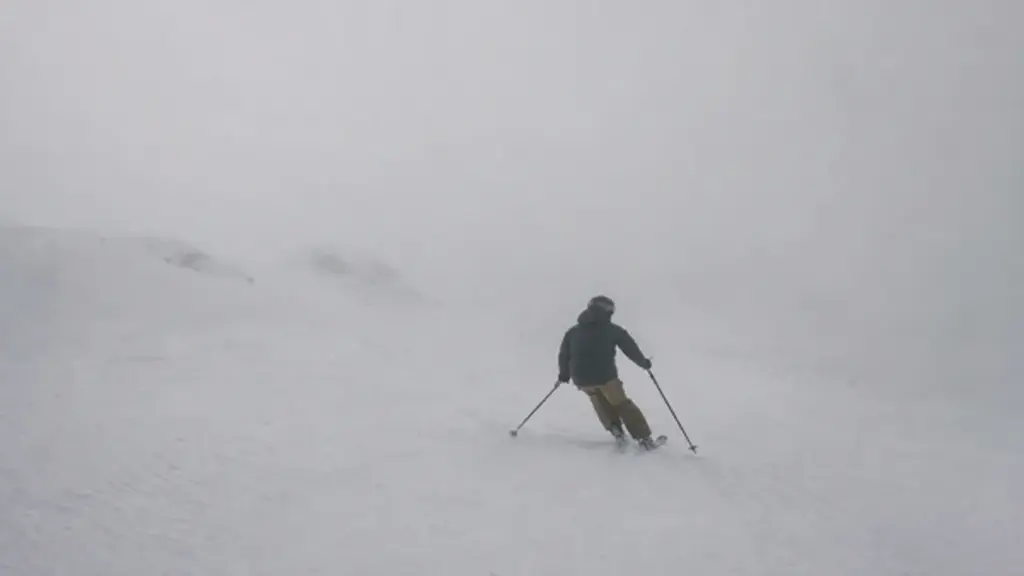
Every skier has made this mistake at least once: wearing the sunny-day mirror lens on an overcast day.
In flat light the clouds diffuse the sun so evenly that nothing casts a shadow. The slope turns into a featureless white sheet: no way to tell a soft bump from a hard ice patch, or where one roller ends and the next begins. A dark lens makes it worse, cutting away the little contrast that’s left.
So go the other way: a high-VLT lens (S1–S2) with a contrast-enhancing tint. Amber, rose and yellow filter parts of the spectrum so texture and shadows stand out against the white. That’s why plenty of skiers carry two lenses, dark for sun and amber for storms.
Photochromic Lenses: One Lens That Adapts
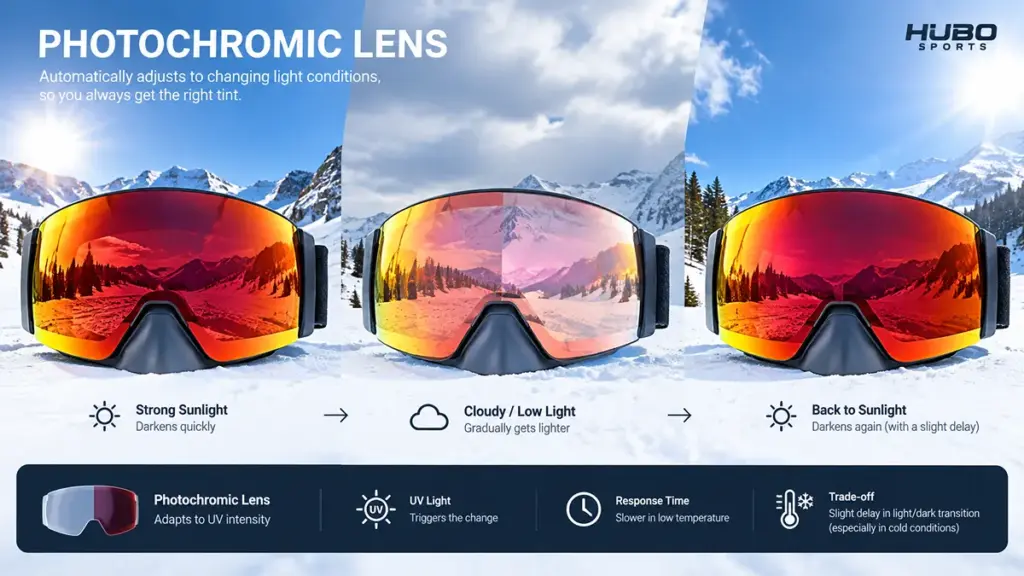
If swapping lenses sounds like a hassle, there’s a middle path: フォトクロミック lenses. Molecules in the lens darken in response to UV, so it gets darker in direct sun and clears when the clouds roll in. A single lens can span several VLT categories in one day.
There are trade-offs. The reaction slows in very cold temperatures, and there’s a lag when you move quickly between shade and glare, ducking into a tree line and back out. Most recreational skiers never notice it. Racers who need instant clarity on demand are still better off with a fixed tint.
How to Choose: A Practical Checklist
Four things to work through before you buy:
- Know your mountain. Do you ski more storm days or sunny ones? Buy for the conditions you actually get, not the ones you’re hoping for.
- Tint is not VLT. Two lenses can share a VLT number and still look nothing alike. Grey is neutral; amber and rose boost contrast. Pick the tint for what it does to contrast, the VLT for how dark it is.
- One lens? An S2 mid-VLT lens with a contrast tint is the safest all-rounder, or a photochromic if you want the lens to adapt on its own.
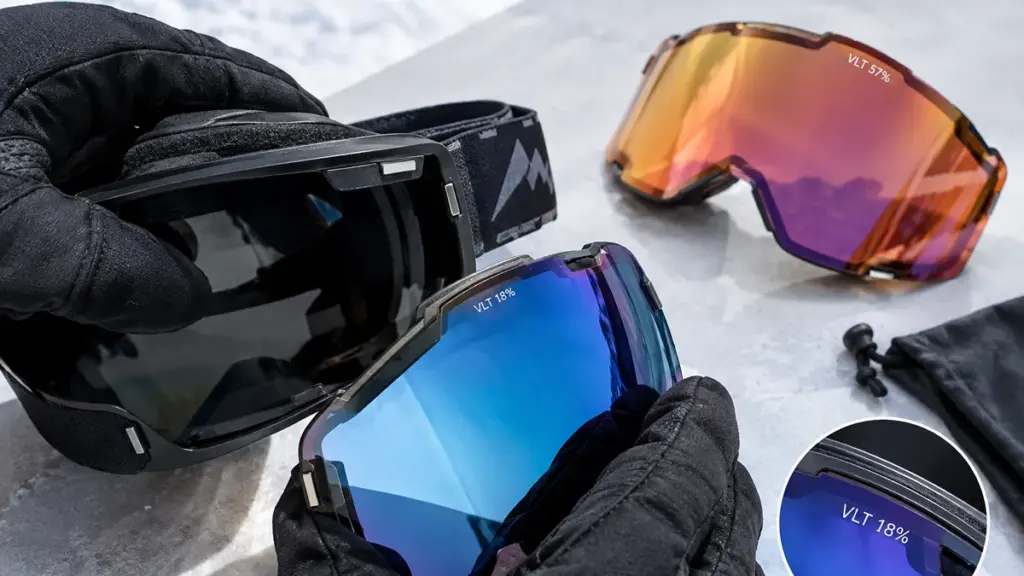
- Check the number. A good lens states its VLT percentage on the lens or the frame. If it doesn’t, you’re buying blind.
VLT is the most useful spec on a goggle lens and the one most riders never check. Learn the number, match it to the light, and you can skip the part where you buy the darkest lens in the shop and spend the afternoon squinting into flat light.