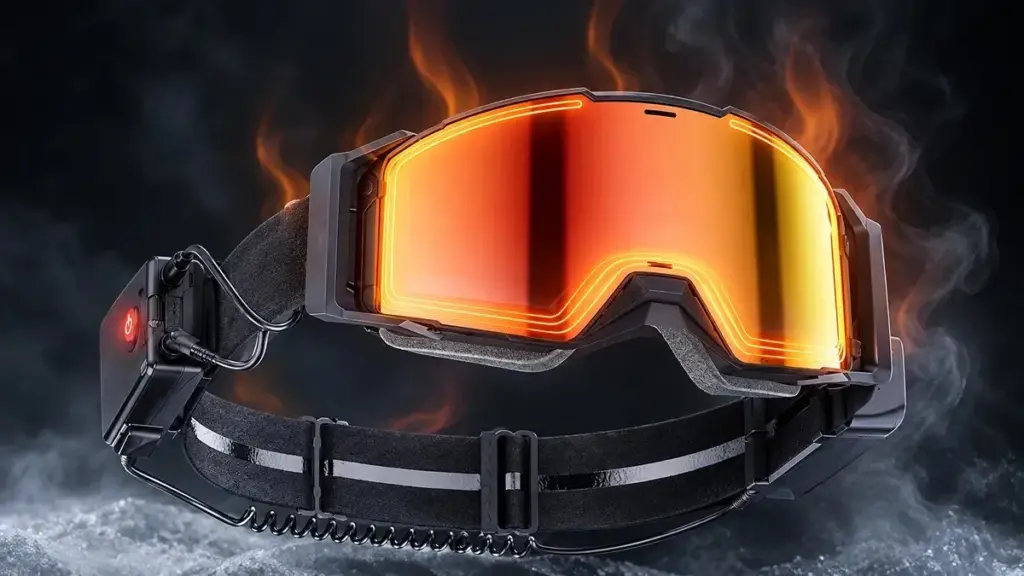
For sports brands, outdoor equipment distributors, and eyewear startups, polarized eyewear represents one of the most lucrative and technically demanding segments in performance optics. Whether developing dedicated fishing eyewear, watersports shades, cycling glasses, or alpine sunglasses, understanding the engineering behind polarization is vital for building competitive, high-margin product lines.
Consumer brands like AquaVision have proven that anglers and outdoor enthusiasts demand optical gear that does more than simply dim ambient sunlight—they want tools that eliminate surface blinding reflections, reveal hidden underwater structure, and alleviate visual fatigue during long expeditions.
This comprehensive OEM guide breaks down the physics of polarized lenses, multi-layer lens architectures, manufacturing methods, tint selection matrices, and rigorous quality control standards to help brand managers and procurement teams build market-winning custom eyewear collections.
1. The Physics of Glare: How Polarized Lenses Actually Work
To communicate product value to end consumers and source the right components from manufacturers, brands must first grasp the optical science behind glare reduction.
The Mechanism of Reflection Glare
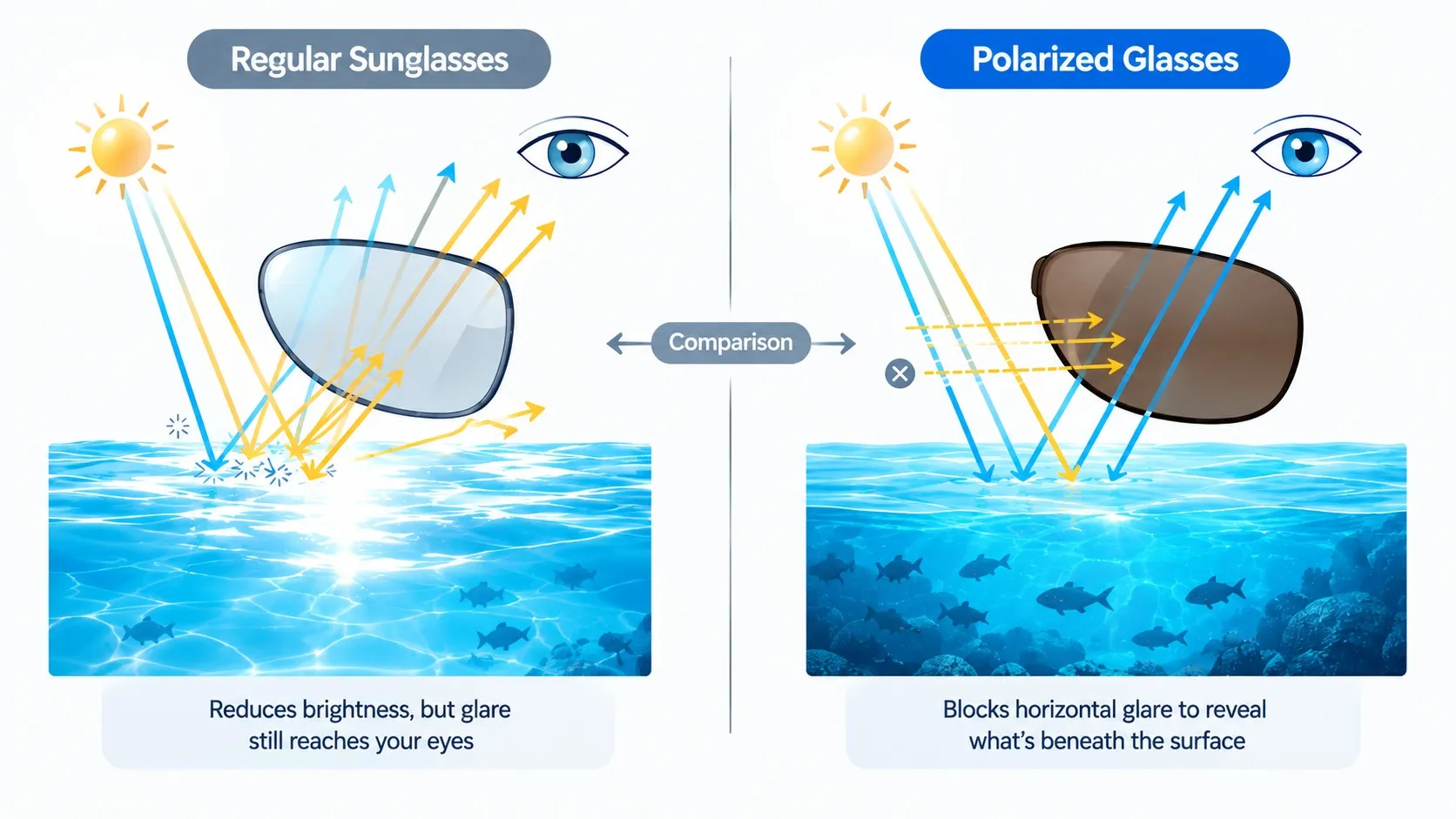
Direct sunlight is unpolarized—its electromagnetic waves oscillate in all directions perpendicular to the direction of propagation. However, when sunlight strikes a smooth, horizontal surface such as water, wet pavement, snow, or sand, a significant portion undergoes specular reflection.
According to Brewster’s Law, reflected light becomes predominantly horizontally polarized. This intense concentration of horizontal light waves creates blinding surface glare, which washes out contrast, conceals contours beneath water surfaces, and triggers eye strain and headaches.
The Vertical Optical Filter
A polarized lens acts as an optical Venetian blind. During the manufacturing process, a polyvinyl alcohol (PVA) film is stretched under controlled heat to align iodine or dichroic dye molecules into microscopic parallel chains oriented vertically.
- Horizontal Glare Blocked: The horizontally oriented light waves cannot pass through the vertical molecular slits.
- Vertical Light Permitted: Useful vertical light—which carries critical information about color, depth, and contrast—passes through freely to the retina.
In fishing applications, this optical filtration eliminates the blinding surface “mirror” reflection, allowing anglers to look directly into the water column to spot structure, weed lines, depth drop-offs, and fish silhouettes. Understanding this physical principle is essential, but translating raw optical theory into durable eyewear requires sophisticated multi-layer manufacturing techniques.
2. Multi-Layer Lens Architecture & Manufacturing Craftsmanship
Not all polarized lenses are created equal. Budget eyewear typically sandwiches a flimsy polarizing film between two basic plastic sheets with minimal bonding, resulting in distortion, haze, and premature delamination. High-performance sports eyewear relies on precision multi-layer composite structures engineered for clarity, impact resistance, and harsh outdoor environments.
The 7-Layer Performance Architecture
A robust sports-grade polarized lens, such as the standard found in professional fishing and outdoor glasses, integrates specialized functional layers:
- Hydrophobic & Oleophobic Top Coat: Repels water droplets, saltwater mist, sweat, and skin oils, allowing moisture to bead off instantly for rapid cleaning.
- Hardened Anti-Scratch Layer: High-density polyurethane or silica coating on the outer surface to protect against abrasive sand, salt crystals, and rough gear handling.
- High-Contrast Optical Tuning Layer: Selectively filters specific wavelengths of light (such as muddy brown or harsh blue wavelengths) to enhance edge definition and depth perception.
- Structural Substrate Layer (PC / TAC / Nylon): Provides mechanical stability, shatter resistance, and optical purity.
- Advanced Polarization Film Core: High-efficiency PVA molecular matrix delivering ≥99% polarization efficiency without optical distortion.
- Rear Multi-Layer Anti-Reflective (AR) Coating: Prevents “backside bounce”—light coming from behind or above the wearer reflecting off the inside lens surface into the eye.
- UV400 Absorption Matrix: Blocks 99.9% to 100% of UVA and UVB rays up to 400nm.
Core Manufacturing Technologies
When establishing technical specifications with your sports sunglasses OEM partner, choosing the proper production method dictates optical performance and unit cost:
| Manufacturing Method | Process Overview | Target Application | Key Advantages |
|---|---|---|---|
| Thermoforming (TAC Lamination) | Triacetate Cellulose (TAC) sheets vacuum-formed over PVA film at precise temperatures. | General sports, entry-to-mid fishing, lifestyle eyewear. | Lightweight, cost-effective, excellent polarization efficiency, low MOQ. |
| Injection Molding (In-Mold PC) | Optical Polycarbonate is injected around a pre-formed polarized wafer inside high-precision molds. | Extreme sports, cycling, shooting, high-impact marine angling. | Exceptional ballistic impact resistance, zero delamination risk, tight curve tolerance. |
| Cast Monomer (Nylon / Polyamide) | Liquid optical resin cast around polarizing film, slowly cured under thermal gradient. | Premium sports brands, ultra-light frames, rimless/semi-rimless designs. | Ultra-low chromatic aberration (Abbe value ~52), stress-free optics, superior chemical resistance. |
Lens Substrate Material Comparison (TAC vs. PC vs. Nylon vs. Glass)
Selecting the right substrate requires balancing impact resistance, optical clarity, and cost targets across your product tiers:
| Material Substrate | Optical Clarity (Abbe Value) | Resistencia al impacto | Weight (Density) | Delamination Risk | Typical OEM Cost Range | Best Suited Application |
|---|---|---|---|---|---|---|
| TAC (Triacetate Cellulose) | Good (~50) | Standard (Meets basic FDA) | Ultra-light (1.27 g/cm³) | Low-Medium (Requires edge sealing) | $ (Budget-friendly) | Entry-to-mid fishing, casual lifestyle, multi-pack retail |
| Polycarbonate (PC) | Moderate (~30) | Exceptional (Ballistic/Shatterproof) | Medium (1.20 g/cm³) | Zero (In-mold bonded) | $$ (Moderate) | High-speed cycling, running, marine sport angling |
| Nylon (Polyamide) | Excellent (~52) | High (Impact & chemical resistant) | Ultra-light (1.02 g/cm³) | Zero (Cast integration) | $$$ (Premium) | Luxury technical sports, rimless & semi-rimless frames |
| Optical Mineral Glass | Superior (~58) | Low (Can shatter upon sharp impact) | Heavy (2.50 g/cm³) | Low (Chemically bonded) | $$$$ (High-end) | Professional deep-sea captains, stationary boat angling |
With these substrate characteristics defined, brand managers can clearly differentiate true polarized performance from basic tinted or standard UV-blocking alternatives.
3. Polarized vs. Standard Tinted vs. UV-Only Lenses: The OEM Specification Matrix
Procurement managers often encounter confusion among B2B buyers regarding the functional boundaries between UV protection, dark tinting, and polarization. Clear product positioning requires defining these differences:
| Feature Dimension | Standard Tinted Sunglasses | UV400 Clear/Fashion Lenses | Premium Polarized Sports Lenses |
|---|---|---|---|
| Primary Function | Reduces overall light transmittance (dims vision). | Blocks UV radiation (invisible light spectrum). | Eliminates horizontal surface glare + blocks UV + enhances contrast. |
| Glare Elimination | No (makes glare darker, but maintains blinding reflections). | No. | Yes (≥99% horizontal glare filtration). |
| Visual Acuity & Depth | Lowers brightness without boosting contrast; can impair low-light depth perception. | Standard visual acuity. | Maximizes depth perception and structure contrast. |
| Eye Fatigue Reduction | Moderate (reduces squinting in direct sun). | Minimal glare relief. | Superior (prevents constant pupil adjustment caused by fluctuating glare). |
| Manufacturing Complexity | Low (single dye injection or dip coating). | Low-to-Moderate (UV additive in resin). | High (precision film alignment, multi-layer bonding, optical curve calibration). |
OEM Technical Note: A dark tinted lens without polarization causes the wearer’s pupils to dilate behind the dark glass. If the lens lacks full UV400 absorption or polarization, more harmful radiation and blinding glare penetrate deep into the relaxed eye, accelerating optical fatigue and long-term damage. This distinction explains why dedicated outdoor athletes require sport-specific polarization tailored to their exact terrain.
4. Sport-Specific Advantages: Why Sports Brands Prioritize Polarization
While polarized eyewear originated in specialized marine markets, today’s sports lifestyle consumers demand tailored polarization across diverse athletic disciplines:
1. Angling & Inshore/Offshore Fishing
- Structure & Fish Detection: Cuts the reflective surface barrier so anglers can identify submerged weed lines, rock piles, drop-offs, and cruising predators.
- Reading Current Seams: Reveals micro-disturbances, foam lines, and feeding zones invisible under surface glare.
- Hook & Eye Safety: Shields eyes from errant lures, weighted rigs, and high-velocity debris when paired with impact-resistant PC/Nylon substrates.
2. Cycling, Running & Triathlons
- Wet Asphalt Glare: Eliminates bright glare from wet roads after rain or morning dew, revealing potholes and oil slicks.
- Transition Acuity: Maintains optical sharpness when cycling through alternating dappled forest shadows and glaring open highways.
3. Alpine & Winter Sports
- Snow Pack Definition: When tuned for snow conditions, polarized lenses differentiate icy patches from soft powder without flattening terrain contours.
- High-Altitude UV Shielding: Protects against intensified UV exposure reflecting off high-albedo snowfields.
4. Marine Watersports (Sailing, Kayaking, SUP)
- Navigation Safety: Allows skippers and paddlers to gauge water depth, reef formations, and underwater obstacles in bright marine environments.
To serve these distinct athletic disciplines effectively, sports brands must offer a thoughtful spectrum of lens tints and light transmission profiles.
5. Lens Tint Engineering & Scenario Matching Guide
For a sports eyewear brand, offering the right tint portfolio is essential. Different environmental conditions require specific Visible Light Transmission (VLT) percentages and chromatic tuning.
1. Amber / Copper / Brown (The Versatile Workhorse)
- VLT Range: 12% – 18%
- Optical Tuning: Selectively filters blue light, boosting red and green contrasts.
- Best Use Case: Stained lakes, inshore flats, rivers, mixed cloud cover, and trail sports.
- Buyer Appeal: The highest-volume SKU for beginner and enthusiast angler collections.
2. Gray / Smoke (Neutral True-Color Optics)
- VLT Range: 10% – 14%
- Optical Tuning: Uniform light attenuation across the entire visible light spectrum without color distortion.
- Best Use Case: High-noon bright sunlight, open waters, road cycling, and everyday outdoor utility.
3. Blue Mirror (Deep Water & High-Glare Specialist)
- VLT Range: 9% – 12%
- Optical Tuning: Base gray or amber lens coated with a multi-layer dielectric blue reflection filter.
- Best Use Case: Offshore big-game fishing, open ocean sailing, and extreme bright marine environments.
4. Yellow / High-VLT Gold (Low-Light & Fog Precision)
- VLT Range: 28% – 35%
- Optical Tuning: High light throughput while suppressing low-wavelength haze.
- Best Use Case: Early morning launch, dusk casting, overcast winter days, and dense canopy trail navigation.
Once your brand has identified the core lens tints for your target demographic, the next step is configuring frame ergonomics, functional coatings, and turnkey retail packaging.
6. Brand Customization & OEM/ODM Options for Sports Brands
Building a custom line of sports sunglasses requires configuring functional components that match brand identity, ergonomic needs, and target price points.
1. Frame Materials & Ergonomics
- Swiss EMS TR90 Grilamid: The gold standard for sports frames—super lightweight, flexible memory retention, and sweat/chemical resistance.
- Floating TPX (Polymethylpentene): Low-density polymer specifically for watersports frames that float on water when dropped.
- Removable Wrap-Around Side Shields: Blocks peripheral ambient glare and wind intrusion, crucial for sight fishing and glacier exploration.
- Co-Molded Hydrophilic Rubber: Temple tips and nose pads that increase grip as perspiration occurs.
2. Custom Lens Enhancements
- REVO Multi-Layer Flash Mirroring: 8–12 layers of dielectric coatings in custom brand colors (Emerald Green, Ice Blue, Ruby Red, Solar Gold).
- Dual-Action Anti-Fog Coatings: Permanent hydrophilic inner coating to prevent fogging during high-exertion sports.
- Laser Logo Etching: Discrete brand logo micro-etched in the upper lens corner without obstructing field of view.
Functional Coating Technologies & Performance Gains
| Coating Technology | Applied Surface | Key Technical Function | Performance Benefit for End-User | Recommended Sport Segment |
|---|---|---|---|---|
| Super Hydrophobic & Oleophobic | Outer Front Lens | Static contact angle > 110°; repels water beads, saltwater spray, finger smudges | Lenses stay clear in heavy spray; wipe clean in seconds without streaking | Offshore fishing, kayaking, sailing, SUP |
| Hardened Diamond Anti-Scratch | Both Sides | 4H–6H pencil hardness silica protective layer | Prevents scratching from abrasive salt crystals, sand, and rough tackle box storage | All outdoor and marine sports |
| Multi-Layer Rear AR (Anti-Reflective) | Inner Back Surface | Green/Blue vacuum sputtering anti-reflection coating | Eliminates “backside bounce” glare reflecting off the wearer’s cheek/temple into the eye | Bright sun angling, snow sports, high-altitude hiking |
| REVO Dielectric Mirror Coating | Outer Front Lens | 8–12 layers of metal oxide vapor deposition | Blocks an additional 10%–15% intense surface glare while adding custom brand color styling | Ocean boating, beach volleyball, glacier sports |
3. Packaging & Turnkey Merchandising Sets
Sports brands achieve higher perceived retail value by bundling complete adventure kits:
- Custom-molded zippered EVA hard cases with carabiner clips.
- High-density microfiber cleaning cloths and storage pouches printed with custom artwork.
- Quick-release floating neoprene straps or anti-fall retainers.
- Interactive Polarized Demonstration Test Cards allowing consumers to visually verify polarization in-store or upon unboxing.
Executing these custom features at scale demands a reliable manufacturing partner backed by comprehensive international testing facilities.
7. Supplier Selection & Quality Control Standards
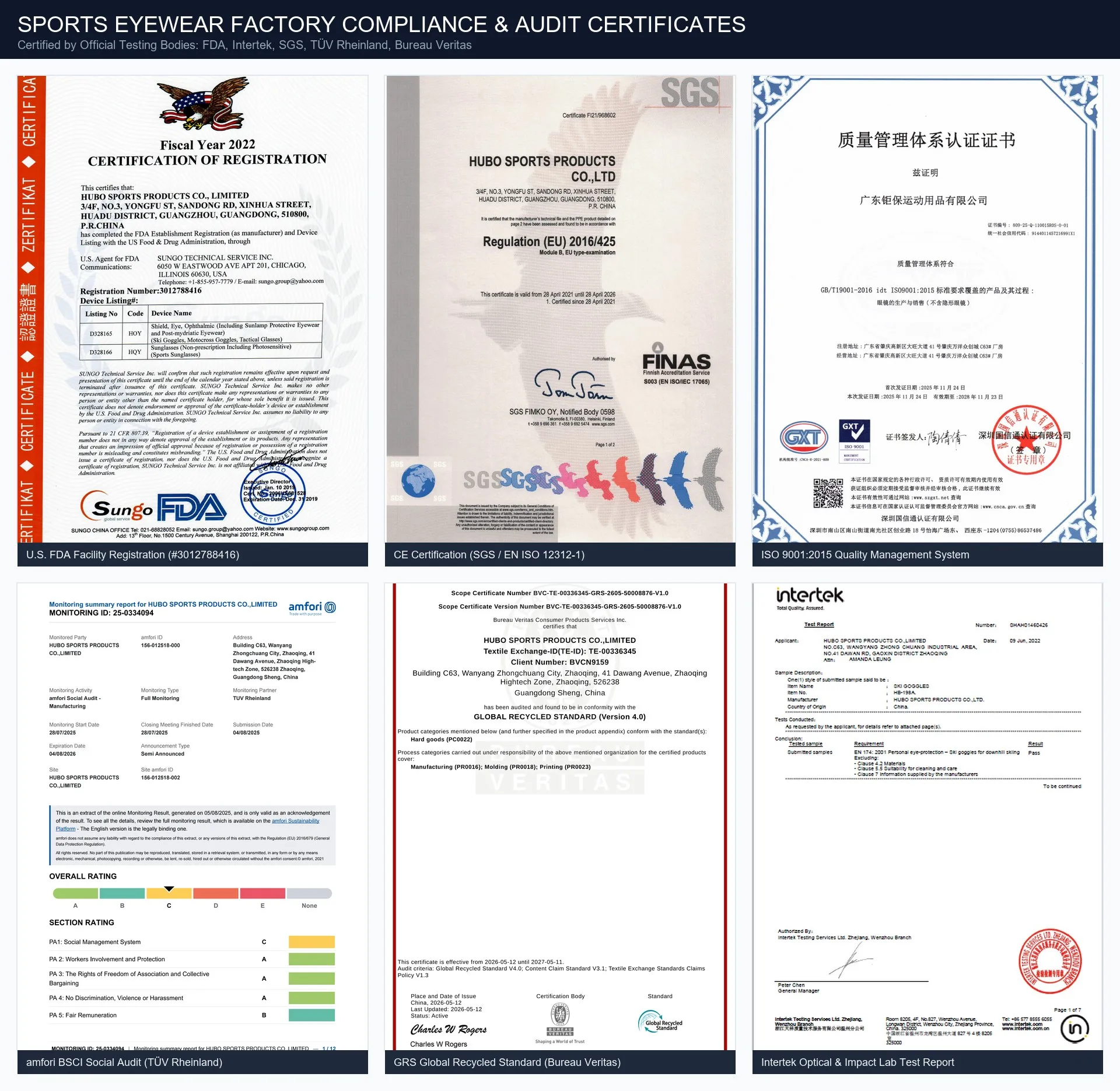
When qualifying an OEM/ODM manufacturing partner for polarized sports eyewear, brand managers must audit factory testing facilities against international safety and optical standards.
Essential International Compliance Standards
| Compliance Standard | Region / Market | Critical Testing Parameters | OEM Pass Criteria | Verification Method |
|---|---|---|---|---|
| ANSI Z80.3:2018 | United States | Polarization efficiency, refractive power, astigmatic power, traffic signal recognition | Polarizing efficiency ≥ 95%; axis deviation ≤ ±2° | Polarimeter & Lensmeter Spectrophotometer |
| EN ISO 12312-1:2022 (CE) | European Union | Category 0–4 luminous transmittance, wide-angle scatter, UV cutoff up to 380/400nm | UV transmittance < 1.0%; zero optical distortion | UV-Vis Spectrophotometer & Distortion Grid |
| AS/NZS 1067.1:2016 | Australia / NZ | Strict UVR absorption (280–400nm) and extreme glare attenuation | Full UV400 absorption; enhanced lens durability | High-intensity UV exposure chamber |
| FDA 21 CFR 801.410 | United States | Impact resistance (Drop Ball Test) | Withstand 5/8″ steel ball drop from 50 inches without fracturing | Impact Drop Ball Test Rig |
Key Questions to Ask Your OEM Manufacturer
- “What is your tolerance for polarization axis deviation across paired lenses?” (Industry benchmark: within ±2°).
- “Do you conduct 100% in-line spectrophotometer checks for UV400 and VLT consistency?”
- “What is your standard warranty and defect rate allowance for lens delamination?”
- “Can you provide third-party lab test reports (SGS / Intertek / TÜV) for FDA registration and CE compliance?”
To further clarify common production considerations, the following FAQ addresses typical inquiries from brand sourcing directors.
8. Frequently Asked Questions (FAQ) for Brand Sourcing Managers
Q1: Are all polarized lenses suitable for sight fishing and marine sports?
No. Standard fashion polarized lenses often use thin, flat 2-to-3 layer TAC sheets that exhibit wave distortion when cut into wrapped sports frames. High-performance fishing eyewear requires decentered, optically correct 7-layer lenses with high polarization efficiency (≥99%) and specific tint formulas (like amber/brown or green/blue mirror) designed to optimize bottom structure contrast.
Q2: What is the typical Minimum Order Quantity (MOQ) for custom polarized sports eyewear?
For standard TAC polarized sunglasses with custom frame colors and logo printing, MOQs typically range from 300 to 600 pairs per style (often split across 2–3 lens colorways). For custom tooling of proprietary injection-molded PC lenses or specialized TR90 frame molds, initial production runs generally start at 1,200 to 2,000 pairs.
Q3: Why do some polarized lenses delaminate after exposure to saltwater?
Delamination occurs when moisture or salt crystals penetrate the lens edges due to inadequate seal lamination or improper thermoforming temperature control. High-quality OEM manufacturers use specialized edge-sealing techniques, hydrophobic barrier coatings, and pressure-autoclave lamination to ensure lifetime adhesion even in marine environments.
Q4: Can polarized sports lenses be combined with prescription (RX) inserts or photochromic technology?
Yes. Professional OEM suppliers offer two main solutions:
- Detachable Inner RX Optical Clips: A lightweight prescription frame snaps behind the polarized outer lens.
- Direct Polarized Photochromic Lenses: Photochromic molecules embedded into the outer substrate allow the lens to dynamically adjust its VLT from Category 2 (cloudy) to Category 3/4 (full sun) while maintaining constant polarization.
Q5: What is the difference between TAC, PC, and Nylon polarized lenses?
- TAC (Triacetate): Lightweight and economical with high polarization clarity. Best for lifestyle and entry-level fishing lines.
- PC (Polycarbonate): Extremely tough, impact-resistant, and shatterproof. Ideal for high-speed sports, cycling, and heavy-duty angling.
- Nylon (Polyamide): Superior optical clarity (high Abbe value), ultra-low stress distortion, and chemical resistance. Preferred for luxury and high-end technical sports brands.
9. Conclusion: Partnering with a Specialized OEM Manufacturer
Developing a winning polarized sports eyewear line requires more than choosing stylish frames—it demands precision optical engineering, durable multi-layer lens technology, and dependable quality assurance.
By partnering with an experienced sports sunglasses OEM/ODM manufacturer, your brand can leverage proven mold libraries, custom lens tint formulations, and international compliance certifications to accelerate time-to-market and maximize profit margins.
Ready to launch or upgrade your brand’s polarized eyewear collection? Contact our technical OEM/ODM engineering team today to request custom lens swatch samples, explore rapid 3D prototyping, and review comprehensive factory audit credentials.