Plenty of skiers know the feeling. You’ve barely finished your first run when the inside of your goggles turns into a white blur. Vision goes soft, so you pull over, take them off and wipe them down. A few turns later, the fog is back. It leaves a lot of people wondering: am I doing something wrong, or are these goggles just not up to the job? The honest answer is that fogging comes from several things working together — temperature difference, humidity, how the goggles are worn, and how they’re built. Once you know which one is causing it, the problem becomes fixable.
When the problem is how you wear them
Some fogging really is down to habit. Even a good pair will fog if you set it up badly.
The usual culprit is the gaiter. Skiers and snowboarders pull a neck tube or face mask up over the nose, and it covers the intake vents along the bottom of the frame. Warm breath now has nowhere to go except up into the goggle chamber, where it hits a cold lens and condenses on contact.
Walking straight from a heated lodge into sub-zero air does something similar. The lens is still warm and holding moisture, and the sudden drop in temperature pulls that moisture out onto the surface.
Fit matters too. If the foam doesn’t sit flush against your face, breath streams into the chamber through the gap all day long. And once you’ve touched the inner lens with a wet glove or a hand full of snow, the anti-fog coating is damaged — after that it fogs faster than it did when new.
None of this is a defect. Change how you wear them and stop touching the inside, and most of it goes away.
When the problem is the goggles
If you’ve fixed all of the above and the fog keeps coming back, look at the equipment.
Entry-level goggles are often single-lens, with no insulating air gap. Warm air and cold air meet across one thin barrier, and moisture condenses almost immediately. Cheap dual-lens models have a different failure: the seal between the two lenses leaks, moisture works its way into the gap, and the fog sits where you can’t reach it. No amount of wiping helps. That one is a manufacturing defect.
Ventilation design decides the rest. Goggles depend on vents at the top and bottom of the frame to move air through and carry moisture out. Undersized vents, vents placed in the wrong spot, or vents buried under the foam all break that airflow, and the moisture just sits inside. When the frame is built that way, adjusting your fit won’t save it.
Passive ventilation also has a ceiling. In heavy humidity, in cold below -15°C, or during hard continuous effort when you’re breathing deeply, airflow alone can’t clear moisture fast enough. The fog comes back no matter how well the goggles are worn.
“Dual-lens goggles don’t fog” isn’t quite true
It’s a common assumption, and it’s only half right. The air gap between two lenses narrows the temperature difference across the inner surface, which makes condensation less likely. Less likely is not the same as impossible. Push a passive system into a cold enough, wet enough environment and it will still fog.
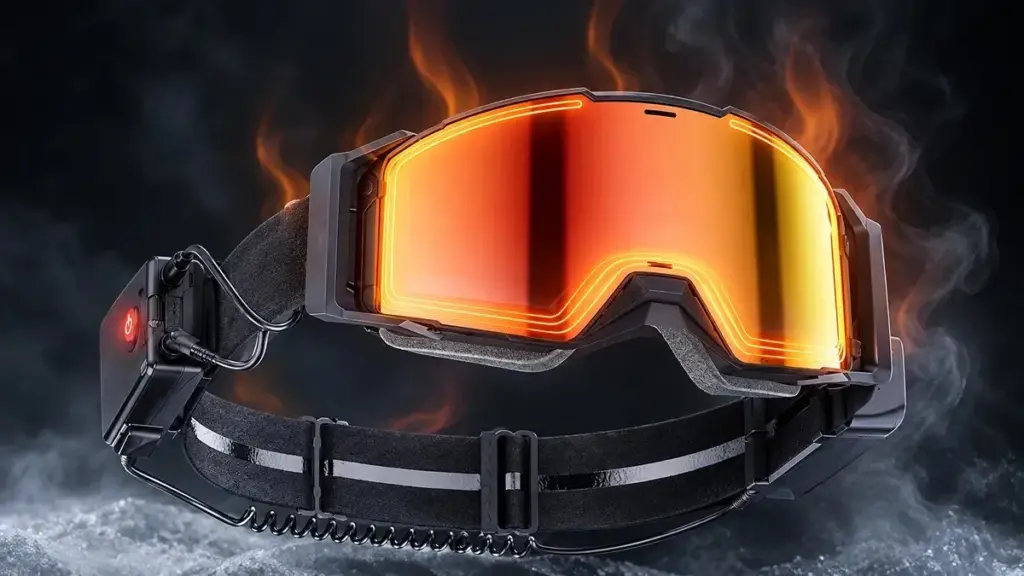
That gap in performance is why heated goggles exist. Running current through the lens keeps its surface above the dew point and evaporates condensation that has already formed, instead of waiting for airflow to carry it away.
A quick way to tell which one you’re dealing with
Try this indoors. Put the goggles on at room temperature, check that nothing is covering the vents and that the foam seals against your face, then breathe normally into them for a few seconds.
A light haze that clears on its own is normal physics — nothing is wrong. Heavy fog that lingers, with the fit already correct, points at the anti-fog treatment or the ventilation design.
The bottom line
Fogging isn’t always the product’s fault. A mask over the vents, a scratched coating, a warm lens carried into cold air — those are habits, and habits can be corrected.
Persistent fog under correct use is a different story, and it usually traces back to lens structure or vent layout. Standard dual-lens goggles handle ordinary resort conditions fine. If most of your days are spent in deep cold, high humidity or the backcountry, an actively heated lens is the more reliable way to keep your view clear.